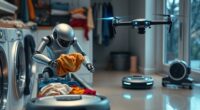
By 2025, nearly 35% of households in developed countries own at least one robot, up from 15% five years ago, driven by affordability and expanding features. These robots now handle chores, security, and companionship, seamlessly integrating with smart home devices. While AI challenges like natural language understanding and privacy concerns exist, ongoing improvements are making robots smarter and more reliable. Stay tuned to discover more surprising statistics about how household robots are reshaping daily life.
Key Takeaways
- Nearly 35% of households in developed countries own at least one household robot in 2025.
- Household robots now perform diverse tasks such as cooking, laundry, gardening, and elder care.
- Market penetration has more than doubled in five years, from 15% to 35%.
- AI integration challenges, like natural language recognition and privacy, slow full adoption but continue to improve.
- Continuous advancements have made household robots smarter, more reliable, and deeply embedded in daily routines.

As household robots become increasingly common in everyday life, their adoption rates and capabilities are reaching new heights in 2025. You’re probably noticing more homes equipped with robotic assistants that handle chores, security, and even companionship. The latest data shows that robot adoption trends are accelerating rapidly, driven by advancements in AI, affordability, and consumer interest. However, integrating AI into these devices isn’t without its challenges. Many manufacturers still grapple with AI integration challenges, such as ensuring these robots understand complex commands, adapt to unique household environments, and maintain privacy standards. Despite these hurdles, the market growth remains robust, with a growing number of households embracing automated solutions.
Household robots are rapidly gaining popularity, handling chores, security, and companionship despite ongoing AI integration challenges.
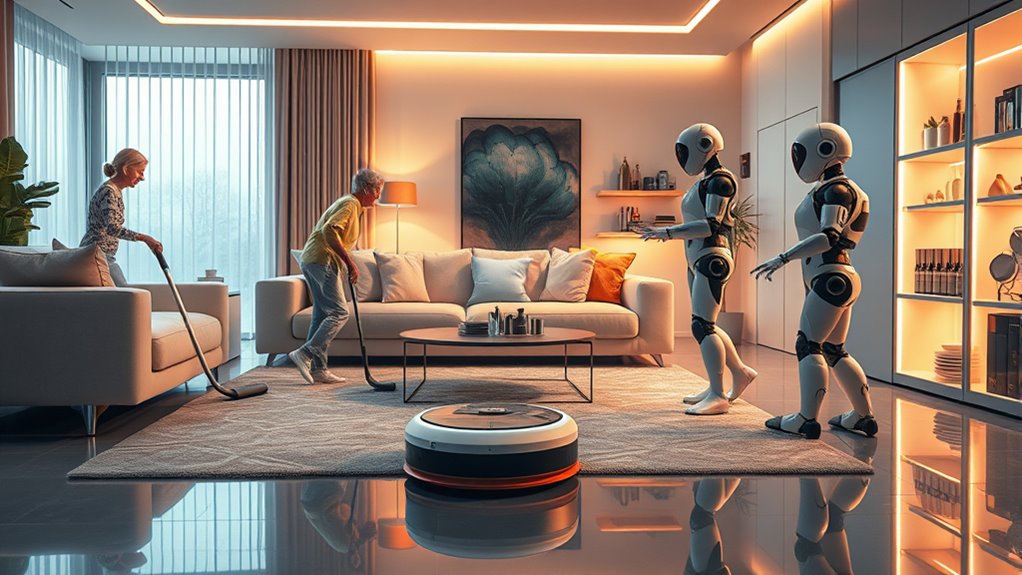
In 2025, surveys indicate that nearly 35% of households in developed countries now own at least one household robot, a significant jump from just 15% five years ago. This surge reflects not only increased affordability but also the expanding capabilities of these robots. They’re no longer limited to vacuuming or basic tasks; many now serve as multi-functional helpers, capable of cooking, laundry, gardening, and even elder care. As you observe your neighbors or friends, you’ll notice that smart home integration has become seamless, with household robots syncing effortlessly with other devices and apps. The growth of AI-powered automation is transforming everyday routines and making household management more efficient.
However, you should also be aware of the persistent AI integration challenges that developers face. For example, making robots reliably recognize and respond to natural language commands in noisy or cluttered environments remains complex. Privacy concerns are another hurdle, as these robots collect sensitive data about your daily routines. Manufacturers need to ensure data security and build trust, which can slow down deployment or limit certain functionalities. Additionally, adapting AI to handle the unpredictable nature of household environments requires ongoing updates and improvements, which can delay full adoption or lead to user frustration.
Despite these challenges, the industry is making significant progress. Many companies are investing heavily in refining AI algorithms, improving robot sensors, and enhancing user interfaces. The result is a more intuitive, adaptable, and useful household robot that’s becoming an integral part of daily life. As you consider the future, it’s clear that the combination of growing adoption rates and ongoing AI integration solutions will shape a household landscape where robots are smarter, more reliable, and more deeply integrated into your routines. This evolution is set to redefine how you manage household tasks and interact with technology in 2025 and beyond.
As an affiliate, we earn on qualifying purchases.
Frequently Asked Questions
How Affordable Will Household Robots Be for Average Families in 2025?
By 2025, household robots will become more affordable for average families due to ongoing cost reduction and increased market penetration. As technology advances and production scales up, prices will drop, making robots accessible to more households. You’ll likely find budget-friendly options that offer essential functions, helping you save time and effort around your home without breaking the bank. These improvements will make household robots a common, affordable addition to everyday life.
What Safety Standards Will Household Robots Meet by 2025?
You might worry about safety, but by 2025, household robots will meet strict safety standards through rigorous testing and regular updates. They’ll comply with global regulations on robot safety and standard compliance, ensuring they operate securely around your family. Manufacturers will prioritize robot safety, incorporating advanced sensors and fail-safes to prevent accidents. Rest assured, these standards are designed to make your smart home safer and more reliable.
How Will Household Robots Impact Employment in Domestic Sectors?
You’ll likely see household robots cause some automation job displacement, especially in routine domestic tasks. However, they’ll also redefine skills needed at home, shifting your focus toward managing and maintaining these devices. This change prompts you to learn new tech-related skills, rather than replace your roles entirely. Overall, while automation impacts employment, it encourages skill redefinition, creating opportunities for those willing to adapt in domestic sectors.
What Are the Privacy Concerns Related to Household Robot Data?
Imagine your household robot quietly listening to your conversations and watching your routines. You should be concerned about privacy breaches and data security, as your personal data could be vulnerable. Unauthorized access might expose your habits, finances, or private moments. To protect yourself, make sure your robot uses strong encryption, updates software regularly, and limits data sharing. Staying vigilant helps safeguard your privacy in a tech-driven home.
Will Household Robots Be Customizable to Individual Household Needs?
Yes, household robots will be highly customizable to fit your needs. You’ll find plenty of personalization options, allowing you to tailor features like cleaning routines or entertainment. Many robots will also feature modular design, so you can add or swap components based on what your household requires. This flexibility guarantees your robot adapts seamlessly to your lifestyle, making it easier to enjoy a smarter, more efficient home.
multi-functional household robot
As an affiliate, we earn on qualifying purchases.
As an affiliate, we earn on qualifying purchases.
Conclusion
Just as Icarus dared to fly closer to the sun, today’s household robots are pushing boundaries, transforming daily life. With over 30 million units expected by 2025, you’re stepping into an era where automation becomes your trusted companion. Embrace this future, where technology’s promise echoes the myth of progress—bold, innovative, and full of potential. As the horizon expands, so does your opportunity to shape a smarter, more efficient home.
As an affiliate, we earn on qualifying purchases.
As an affiliate, we earn on qualifying purchases.