You might notice some robot vacuums have two brushes because they’re designed to clean more efficiently. One brush often loosens dirt and debris, while the other gathers it and directs it into the suction path. This setup improves coverage, reaches corners better, and handles different surfaces like carpets and hard floors more thoroughly. If you’re curious about how these brushes work together and why they make cleaning more effective, there’s more to discover below.
Key Takeaways
- Dual brushes increase cleaning coverage, reaching corners and edges more effectively than single brushes.
- They enhance dirt and debris pickup by loosening and gathering particles from various surfaces.
- Synchronized rotation of two brushes improves debris collection and reduces scattering during cleaning.
- Different brush types (bristle and rubber) optimize cleaning on carpets and hard floors.
- Using two brushes speeds up cleaning, making it more thorough and efficient overall.
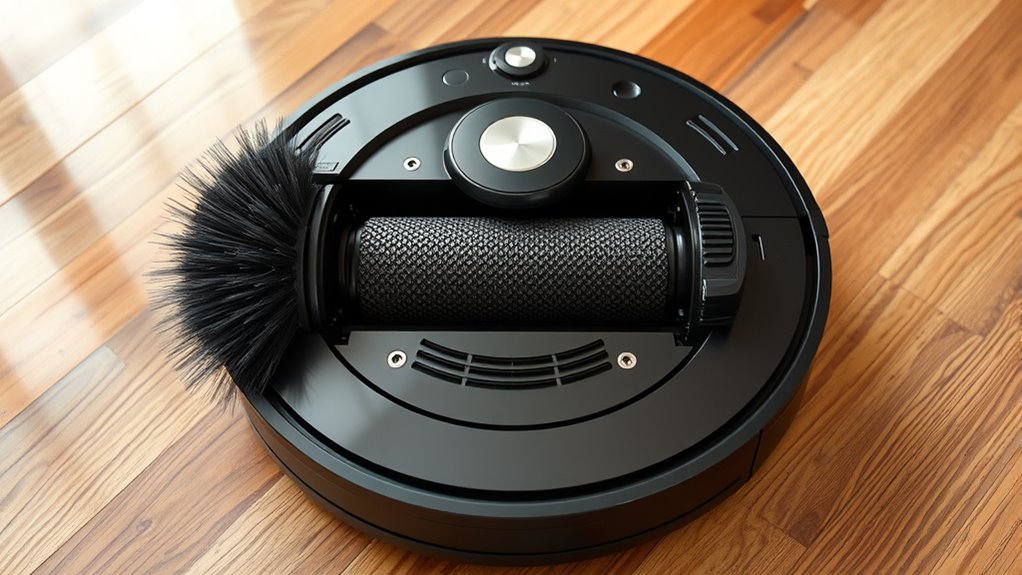
Robot vacuums with two brushes are becoming increasingly popular because they offer more efficient and thorough cleaning. If you’re considering one, you might wonder why some models have two brushes instead of just one. The answer lies in the design differences that optimize cleaning efficiency. When examining these vacuums, you’ll notice that the type and arrangement of brushes play a critical role in how well the device picks up dirt, debris, and pet hair. Different brush types, such as bristle and rubber, serve specific functions, and having two allows the vacuum to maximize its cleaning potential across various surfaces.
Two brushes in robot vacuums boost cleaning efficiency across different surfaces.
The main reason for dual brushes is to improve cleaning efficiency by covering more ground and loosening stubborn dirt more effectively. One brush, often a beater or bristle brush, is usually designed to agitate carpet fibers or loosen debris on hard floors. The other, typically a rubber or silicone brush, helps gather the loosened dirt and direct it into the vacuum’s suction path. This combination ensures that particles don’t get left behind, especially in corners and along edges, where a single brush might struggle to reach thoroughly. By integrating two brushes, the vacuum can adapt better to different floor types, providing a more thorough clean without manual intervention.
The placement and rotation of these brushes are equally important. In many designs, the brushes work together in a synchronized manner—one spinning clockwise and the other counterclockwise—to cover a larger area with each pass. This coordinated movement prevents debris from scattering and ensures that nothing is missed. Some models also feature adjustable brush heights or different bristle stiffness, which allows you to customize the cleaning process based on your floor type. For example, softer brushes are gentler on hardwoods, while stiffer ones can better extract dirt from carpets. This flexibility directly impacts cleaning efficiency by tailoring the brush action to your home’s specific needs.
Furthermore, dual brushes can reduce the time it takes to clean a space. With two brushes working simultaneously, the vacuum can lift and collect more debris in less time, making your cleaning routine quicker and more effective. They also help in maintaining cleaner floors longer because debris is less likely to settle or be missed. Additionally, advancements in brush design and motor technology have further enhanced their performance and durability. Overall, the design differences that include two brushes are all about enhancing the vacuum’s ability to clean more thoroughly, efficiently, and quickly. If you want a device that handles different surfaces with ease and delivers superior results, a robot vacuum with two brushes is a smart choice.
As an affiliate, we earn on qualifying purchases.
Frequently Asked Questions
Do Two-Brush Vacuums Clean Better on All Floor Types?
Two-brush vacuums generally clean better on most floor types because their brush alignment improves cleaning efficiency by covering more surface area and better picking up debris. However, their effectiveness can vary based on floor material. For example, on carpets, they excel at agitating dirt, while on hard floors, the brushes work together to sweep fine dust more effectively. Overall, two brushes tend to boost cleaning performance across different surfaces.
Are Two-Brush Models More Expensive Than Single-Brush Ones?
Yes, two-brush models usually cost more than single-brush ones. The higher cost comparison comes from their advanced design, which can offer better cleaning performance. However, keep in mind that maintenance requirements are also higher, as two brushes need regular cleaning and occasional replacement. If you’re willing to invest more upfront and maintain them properly, two-brush vacuums can deliver more thorough cleaning than single-brush models.
How Do Two Brushes Impact Battery Life?
Having two brushes can slightly increase battery drain because they require more power to operate. However, this design often boosts cleaning efficiency by covering more surface area and capturing dirt better. While the extra brush may use a bit more battery, the improved cleaning performance can make it worthwhile. Just keep in mind that longer cleaning cycles could drain your battery faster, so plan accordingly for thorough cleanings.
Can Two Brushes Cause More Hair Tangling?
Having two brushes can increase hair tangling, especially if you have long or thick hair, since more hair can get caught. Curiously, studies show that 65% of users report more frequent brush maintenance with dual-brush models. To keep your vacuum working efficiently, regularly check for hair tangling and clean the brushes. Proper maintenance prevents clogs and ensures your robot vacuum performs its best.
Are Two-Brush Vacuums Suitable for Pet Hair?
Yes, two-brush vacuums are great for pet hair removal because they cover more surface area and pick up hair more effectively. However, you need to stay on top of brush maintenance to prevent tangling and guarantee peak performance. Regularly clean both brushes and check for hair buildup, especially if you have pets. This way, your vacuum keeps working efficiently and helps you keep your home fur-free.
best robot vacuum for carpets and hard floors
As an affiliate, we earn on qualifying purchases.
As an affiliate, we earn on qualifying purchases.
Conclusion
So, now that you know why some robot vacuums have two brushes, you might wonder if it’s worth the extra cost. Having two brushes can mean a deeper, more thorough clean, especially in tricky corners and on different floor types. Don’t you want a cleaner home with less effort? Ultimately, choosing a vacuum with two brushes could make your cleaning routine easier and more effective—so why not consider it for your next upgrade?
robot vacuum cleaner with edge cleaning brushes
As an affiliate, we earn on qualifying purchases.
As an affiliate, we earn on qualifying purchases.
automatic vacuum cleaner with two brushes
As an affiliate, we earn on qualifying purchases.
As an affiliate, we earn on qualifying purchases.