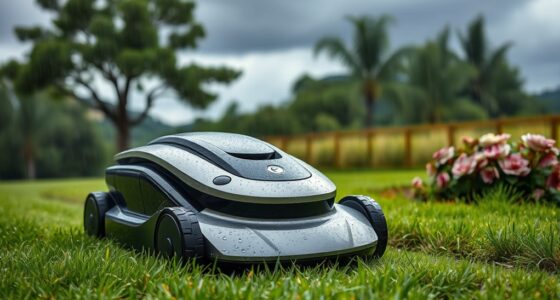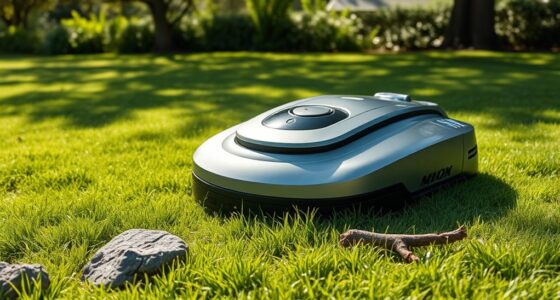
Robotic lawn mowers cut differently because they use sensors, boundary wires, and smart navigation to adapt their route and avoid obstacles, resulting in a more uniform and precise cut. Unlike traditional mowers that follow straight or random lines, robotic mowers continuously adjust to grass health and growth, ensuring a healthier, evenly trimmed lawn. If you want to understand how these advanced features work together for a better lawn, keep exploring.

Get home appliances delivered free with Prime
- Fast, free delivery on millions of items
- Prime Video, Amazon Music and more included
- Member-only deals all year
Key Takeaways
- Robotic mowers use sensors and boundary wires for precise, adaptive route planning, unlike traditional mowers’ fixed straight or random cuts.
- They typically operate in smaller, more controlled segments, resulting in more uniform and healthier grass.
- Robotic mowers adjust their paths automatically to avoid obstacles and cover the entire lawn efficiently.
- Advanced navigation systems enable robotic mowers to access tight corners and edges more effectively than traditional models.
- Their scheduled, automated operation allows for consistent mowing patterns, promoting better lawn health.

When it comes to maintaining your lawn, choosing between robotic lawn mowers and traditional gas or electric mowers can substantially impact your time, effort, and overall yard care. Robotic mowers operate on batteries, which influences their cutting behavior and efficiency. Unlike traditional mowers that rely on fuel or corded electricity, robotic models use rechargeable batteries designed for maximum battery efficiency. This means they can run for a set period before needing a recharge, often around 1 to 2 hours, depending on the model. Because they are programmed to mow in small, overlapping sections repeatedly, they tend to create a more even cut over time. Their battery efficiency ensures that they can cover your yard consistently without the need for frequent recharges, reducing downtime and keeping your lawn looking neat.
Another key difference lies in their noise levels. Traditional gas-powered mowers are notoriously loud, producing noise that can be disruptive, especially if you have neighbors nearby or if you prefer a quiet outdoor environment. Electric mowers are quieter than gas models but still produce noticeable noise, which can be a concern if you’re sensitive to sounds. Robotic mowers, however, operate with a fraction of the noise, often comparable to a human conversation or background household noise. This quiet operation allows you to run your mower during early mornings or late evenings without disturbing your household or neighbors. Their low noise levels are particularly advantageous if you want to mow frequently without drawing attention or causing noise pollution. Additionally, robotic mowers utilize advanced sensor technology to detect obstacles and adjust their route accordingly, which enhances their ability to provide a consistent and precise cut. The way robotic mowers cut also differs considerably from traditional models. While traditional mowers cut in straight lines or random patterns depending on the design, robotic mowers are equipped with sensors and boundary wires that guide their path. They constantly adjust their route to avoid obstacles and ensure complete coverage. This method results in a more uniform cut and healthier grass, as the mower doesn’t leave uncut patches or cause uneven wear. Furthermore, robotic mowers employ smart navigation systems that enable them to adapt to changes in the yard over time, improving their efficiency. Their compact size also allows them to access tight corners and edges more easily than traditional mowers, which often require manual trimming afterward. They can also be programmed to mow at specific times, providing a level of automation that simplifies lawn care. Additionally, many robotic mowers incorporate grass health monitoring features, allowing them to optimize their mowing patterns based on the growth rate and condition of your lawn.
robotic lawn mower with boundary wire
As an affiliate, we earn on qualifying purchases.
As an affiliate, we earn on qualifying purchases.
Frequently Asked Questions
How Do Robotic Mowers Handle Uneven Terrain?
Robotic mowers handle uneven terrain through advanced sensor technology and terrain adaptation features. You’ll find that sensors detect changes in ground level and obstacles, guiding the mower around bumps and slopes. Many models automatically adjust their cutting height and speed to match terrain conditions, ensuring an even cut. This smart adaptation allows robotic mowers to efficiently navigate challenging yards, providing consistent results without you needing to manually intervene.
Can Robotic Mowers Mow in the Rain?
Sure, robotic mowers can mow in the rain—if they’re designed for rain resistance. Ironically, their precision in cutting can suffer in wet conditions, risking slipping or uneven grass. While some models handle the moisture well, many aren’t meant for heavy rain. If you want consistent, clean cuts, it’s best to let the mower stay dry; rain can compromise cutting precision and the device’s longevity.
Do Robotic Mowers Require Wi-Fi Connection?
No, robotic lawn mowers typically don’t require Wi-Fi connection for operation. They often use a simple Wi-Fi setup mainly for remote control, app management, or firmware updates. Once set up, you can control or monitor your mower via a dedicated app, even from afar. However, some advanced models with smart features might need Wi-Fi for real-time control or integration with smart home systems.
How Loud Are Robotic Mowers Compared to Traditional Ones?
Robotic lawn mowers are considerably quieter than traditional mowers, making them ideal for peaceful neighborhood environments. Their noise levels typically range between 60 to 70 decibels, comparable to a conversation, while traditional mowers can reach 85 to 100 decibels, akin to a lawnmower or loud music. The sound comparison shows robotic mowers operate with minimal disruption, allowing you to enjoy your yard without the loud noise that comes with conventional mowing.
What Is the Typical Lifespan of a Robotic Mower?
Your robotic mower typically lasts around 5 to 8 years, depending on usage and maintenance. As it ages, battery degradation can reduce run time, but its cutting precision remains sharp with proper care. Think of it like a trusty steed—over time, parts may wear, but with regular upkeep, your mower continues to trim your lawn with the same finesse, turning your yard into a masterpiece year after year.
quiet electric robotic lawn mower
As an affiliate, we earn on qualifying purchases.
As an affiliate, we earn on qualifying purchases.
Conclusion
In the end, robotic lawn mowers cut differently because they use precise, sensor-based navigation to mow in a random pattern, unlike traditional mowers that follow a straight line. Did you know that robotic mowers can cover up to 0.4 acres on a single charge? This efficiency means you get a more even cut with less effort. So, if you want a perfectly manicured lawn without the hassle, robotic mowers are worth considering.
battery-powered robotic lawn mower
As an affiliate, we earn on qualifying purchases.
As an affiliate, we earn on qualifying purchases.
advanced sensor robotic lawn mower
As an affiliate, we earn on qualifying purchases.
As an affiliate, we earn on qualifying purchases.
Cold & flu season Picks
humidifiers
As an affiliate, we earn on qualifying purchases.