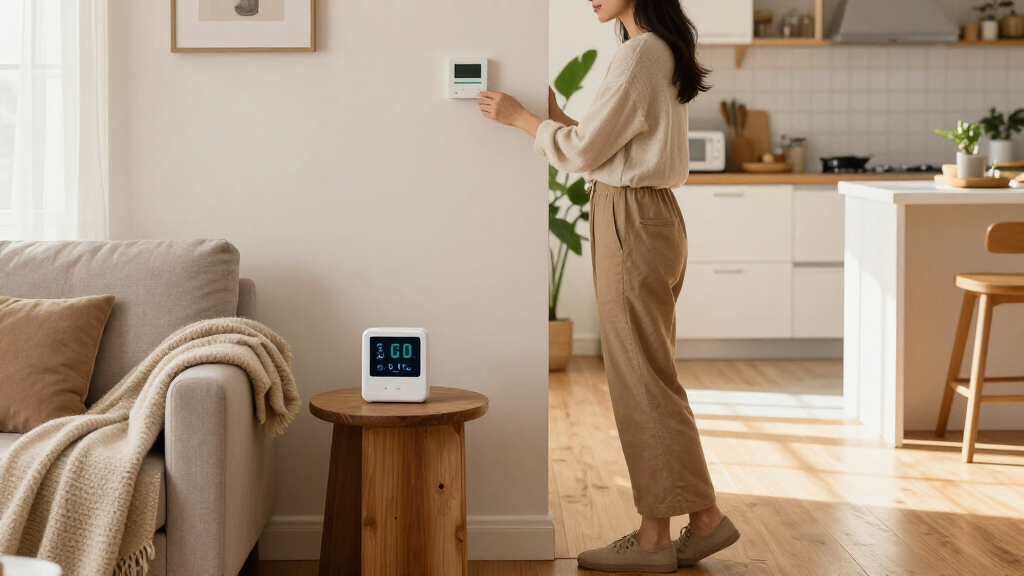
Smart thermostats with room sensors solve a problem a single wall thermostat never can: uneven temperatures between rooms. In this comparison, the ecobee Comfort and Security Bundle with Smart Thermostat Premium earns the top spot for its multi-sensor support, built-in air quality monitoring, and the most flexible room-priority system available. The Google Nest Learning Thermostat (4th Gen) stands out for people who want the thermostat to figure out schedules on its own, while the Honeywell Home ElitePRO S1200 appeals to buyers who prioritize responsive room balancing and a polished app. The main tradeoff in this category is between intelligence and control — some models decide for you, others let you fine-tune everything. Sensor compatibility, ecosystem lock-in, and whether occupancy detection is included also separate these options more than price does. Keep reading for the full breakdown of all nine models and which one fits your home.

Get home appliances delivered free — and shop member deals
- Fast, free delivery on millions of items
- Access to Prime Big Deal Days deals on October 6–7
- Prime Video, Amazon Music and more included
Complete the kit


Key Takeaways
- Multi-sensor support is the biggest differentiator: ecobee models handle up to 32 sensors while some Nest bundles cap out at the single included sensor, requiring add-ons for whole-home coverage.
- Two Nest Learning Thermostat (4th Gen) entries made the list because finish and sensor generation differ — the Obsidian bundle ships with the 2nd Gen sensor, which has better range than the original.
- Occupancy detection is not standard across this category: only the TQX Matter thermostat and ecobee models use presence to actively redirect heating and cooling to occupied rooms.
- The ecobee4, despite its built-in Alexa, is an older platform — buyers get better long-term software support from the newer ecobee Premium bundle for a modest step up.
- The Provirtec 7-day programmable model is the only truly budget-friendly entry, but it trades away smart learning and ecosystem integrations, making it best for simple, fixed schedules.
| Honeywell Home ElitePRO S1200 Smart Thermostat with Room Sensor, White |  | Best for Complex HVAC Systems | Model: YTHX1200W5/U | Included sensor: C7189R3010 wireless room sensor | Room sensor capacity: Up to 20 sensors | VIEW LATEST PRICE | See Our Full Breakdown |
| Google Nest Thermostat E Smart Thermostat with Nest Temperature Sensor Bundle – White |  | Best for Beginners | Color: White | Compatibility: Combi boilers, heat-only boilers, heat pumps (heating only), zoned systems, district heating; 95% of systems | Installation time: Typically 60 minutes or less | VIEW LATEST PRICE | See Our Full Breakdown |
| Google Nest Learning Thermostat (4th Gen, 2024) with Temperature Sensor, Polished Silver |  | Best Premium Design | Generation: 4th Gen (2024) | Color: Polished Silver | System compatibility: Most 24V systems (forced-air, heat pump, radiant, zoned) | VIEW LATEST PRICE | See Our Full Breakdown |
| ecobee Comfort and Security Bundle with Smart Thermostat Premium and SmartSensor |  | Best Overall | Included devices: Smart Thermostat Premium and SmartSensor | HVAC compatibility: 95% of systems | Energy certification: ENERGY STAR certified | VIEW LATEST PRICE | See Our Full Breakdown |
| Provirtec Smart Thermostat with Room Sensor, 7-Day Programmable |  | Best Value Pick | HVAC compatibility: 3H2C; over 95% of 24VAC systems | Programming: 7-day programmable | Modes: Sleep, Home, Away | VIEW LATEST PRICE | See Our Full Breakdown |
| TQX Matter Wi-Fi Thermostat with Occupancy Detection and Remote Sensor Support |  | Best for Smart-Home Automation Fans | Connectivity: Matter-enabled smart-home speaker | Occupancy detection: Millimeter-wave sensor | Remote sensor support: Up to 5 QSZ Remote Sensors | VIEW LATEST PRICE | See Our Full Breakdown |
| Honeywell Home X8S Premium Smart Wi-Fi Thermostat with Room Sensor |  | Best Premium Smart-Home Hub | Display: 5-inch touchscreen | Included sensor: Wireless room sensor, up to 200 ft range | Smart home compatibility: Matter, Amazon Alexa, Google Assistant, Apple Home | VIEW LATEST PRICE | See Our Full Breakdown |
| ecobee4 Smart Thermostat with Built-In Alexa and Room Sensor |  | Best Value Voice-Control Pick | Brand: ecobee | Model: ecobee4 | Built-in features: Alexa Voice Service, room sensor included | VIEW LATEST PRICE | See Our Full Breakdown |
| Google Nest Learning Thermostat (4th Gen) with Nest Temperature Sensor (2nd Gen), Obsidian |  | Best Set-and-Forget Learning Thermostat | Generation: 4th gen thermostat with 2nd gen temperature sensor | Color: Obsidian | System compatibility: Most 24V heating and cooling systems | VIEW LATEST PRICE | See Our Full Breakdown |
| smart thermostats with room sensor | Connectivity |
|---|---|
| Honeywell Home ElitePRO S1200 | Dual-band Wi-Fi, Bluetooth, Matter, RedLINK 3.0 |
| Google Nest Thermostat E Smart | — |
| Google Nest Learning Thermosta | Wi-Fi, Bluetooth |
| ecobee Comfort and Security Bu | — |
| Provirtec Smart Thermostat wit | 2.4GHz WiFi, BT Mesh |
| TQX Matter Wi-Fi Thermostat wi | Matter-enabled smart-home speaker |
| Honeywell Home X8S Premium Sma | — |
| ecobee4 Smart Thermostat with | Wi-Fi |
| Google Nest Learning Thermosta | — |
More Details on Our Top Picks
Honeywell Home ElitePRO S1200 Smart Thermostat with Room Sensor, White
Where most options in this roundup handle standard two-stage homes, the ElitePRO S1200 is built for demanding setups — up to 4 heat / 2 cool stages on heat pumps and support for up to 20 wireless room sensors. That sensor ceiling dwarfs the ecobee Comfort and Security Bundle’s single SmartSensor, making it the stronger choice for multi-zone houses where one prioritized room isn’t enough. It also monitors humidity, VOCs, estimated CO2, and occupancy, and can control two indoor air quality devices directly. The tradeoff is real: it requires a C-wire, the adapter is sold separately, and the doorbell integrations it advertises need hardware you buy apart. Compared with the Nest Learning Thermostat’s single-sensor approach, this model trades simplicity for scale.
Pros:- Supports up to 20 wireless room sensors for whole-home temperature averaging
- Handles complex multi-stage heat pump and conventional systems
- Built-in monitoring of humidity, VOCs, estimated CO2, and occupancy
- Matter support plus RedLINK 3.0 for wide platform flexibility
Cons:- C-wire required and the power adapter is sold separately
- Advertised doorbell and some IAQ accessories are separate purchases
- Overkill in cost and complexity for basic single-stage homes
Best for: Owners of multi-stage heat pumps or zoned, whole-home systems who want sensor coverage in many rooms
Not ideal for: Renters or owners of simple single-stage systems who don’t have a C-wire — the installation burden outweighs the capability
- Model:YTHX1200W5/U
- Included sensor:C7189R3010 wireless room sensor
- Room sensor capacity:Up to 20 sensors
- Heat pump support:Up to 4 heat / 2 cool stages
- Conventional support:Up to 3 heat / 3 cool stages
- Display:5-inch color touchscreen
- Connectivity:Dual-band Wi-Fi, Bluetooth, Matter, RedLINK 3.0
- Power:24 VAC; C-wire required
Our verdict“This pick makes the most sense for large or multi-zone homes that need many sensors and heavy-duty staging — everyone else should start with the ecobee bundle.”
Google Nest Thermostat E Smart Thermostat with Nest Temperature Sensor Bundle – White
The Nest Thermostat E remains the gentlest entry point into sensor-based climate control. It learns your schedule automatically, so there’s no programming curve, and the bundled Nest Temperature Sensor lets you tell it which room matters most — usually a bedroom or nursery. Installation typically takes under 60 minutes with everything included in the box, which is friendlier than the Nest Learning Thermostat (4th Gen), where professional installation is recommended. Compared with the ecobee Smart Thermostat Premium, it skips air quality monitoring and security features entirely, but that restraint keeps the interface simple. The main limitation: some systems, like cooling-only heat pumps, won’t work, and both Home/Away Assist and sensor prioritization depend on the Nest app rather than the hardware itself.
Pros:- Learns temperature preferences and builds its own schedule
- Bundled remote sensor prioritizes comfort in a chosen room
- Installs in about 60 minutes with a full kit included
- Works with Alexa and Google Assistant voice control
Cons:- Incompatible with some systems, including cooling-only heat pumps
- Home/Away Assist and remote sensor control depend entirely on the Nest app
Best for: First-time smart thermostat buyers who want self-programming comfort without a setup project
Not ideal for: Households with cooling-only heat pumps or those wanting air quality monitoring — check compatibility and consider the ecobee bundle instead
- Color:White
- Compatibility:Combi boilers, heat-only boilers, heat pumps (heating only), zoned systems, district heating; 95% of systems
- Installation time:Typically 60 minutes or less
- Voice assistants:Alexa, Google Assistant
- Included items:Thermostat E, Nest Temperature Sensor, installation kit
- Smart features:Home/Away Assist, Nest Leaf, Energy History, remote control via Nest app
Our verdict“This option stands out for buyers who want set-and-forget learning with one prioritized room — skip it if your heating system falls outside its compatibility list.”
Google Nest Learning Thermostat (4th Gen, 2024) with Temperature Sensor, Polished Silver
The 4th-gen Nest Learning Thermostat is the design-forward choice here — the polished silver finish and learning engine make it the thermostat you’d want visible on a living room wall. Its broad 24V compatibility covers forced-air, heat pump, radiant, and zoned systems, and the included temperature sensor gives it room-based control similar to the Nest Thermostat E bundle, but with a more refined hardware experience. Where it stumbles next to rivals: Google recommends professional installation, unlike the self-install Thermostat E, and it runs on a nonstandard battery — an odd choice when the Honeywell ElitePRO and ecobee Premium run on hardwired 24V power. Buyers are paying a premium for aesthetics and learning software, not raw capability.
Pros:- Sleek polished silver design suited to visible wall placement
- Compatible with most 24V systems including radiant and zoned setups
- Learning software adapts the schedule to your habits
- App control over Wi-Fi and Bluetooth with included temperature sensor
Cons:- Professional installation is recommended, adding cost
- Requires a nonstandard battery rather than hardwired power
- Fewer sensor and monitoring capabilities than similarly priced rivals
Best for: Design-conscious homeowners who want a learning thermostat that looks as good as it performs
Not ideal for: DIYers on a budget — the recommended professional install and premium price push total cost well above the Nest Thermostat E
- Generation:4th Gen (2024)
- Color:Polished Silver
- System compatibility:Most 24V systems (forced-air, heat pump, radiant, zoned)
- Connectivity:Wi-Fi, Bluetooth
- Display:LCD
- Included accessory:Nest Temperature Sensor
- Power:1 nonstandard battery required
Our verdict“This model is better suited to style-minded buyers who value the learning experience and finish — practical buyers get more features per dollar from the ecobee bundle.”
ecobee Comfort and Security Bundle with Smart Thermostat Premium and SmartSensor
This bundle earns the top spot because it balances capability, compatibility, and ease of setup better than anything else here. The Smart Thermostat Premium works with 95% of HVAC systems, ships with a Power Extender Kit for homes without a C-wire — a direct advantage over the Honeywell ElitePRO, which makes you buy that adapter separately — and the included SmartSensor tackles hot and cold spots with a 120-degree motion arc. Unlike the Nest Thermostat E, it adds built-in air quality monitoring, smoke-alarm detection, and filter reminders. The catch: motion and entryway alerts are locked behind a paid Smart Security subscription, and HVAC compatibility still needs checking before purchase. Still, for most homes it delivers the most complete sensor-driven package without the Honeywell’s complexity.
Pros:- Compatible with 95% of HVAC systems and ENERGY STAR certified
- Power Extender Kit included for homes lacking a C-wire
- SmartSensor reduces hot and cold spots with motion detection
- Built-in air quality monitoring, smoke-alarm detection, and filter reminders
Cons:- Motion and entryway security alerts require a paid subscription
- Compatibility must be verified before purchase
- Only one sensor included compared to multi-sensor rivals
Best for: Homeowners who want sensor-based comfort plus air quality insight in one well-rounded package
Not ideal for: Buyers who refuse subscriptions — the security features that justify the bundle’s name cost extra monthly
- Included devices:Smart Thermostat Premium and SmartSensor
- HVAC compatibility:95% of systems
- Energy certification:ENERGY STAR certified
- Heating and cooling savings:Up to 26% per year
- Motion detection:Up to 120° arc, 16 feet
- Included accessories:Power Extender Kit and Trim Kit
- Security subscription:Required for some motion and entryway alerts
Our verdict“The strongest all-around pick for most homes — just budget for the subscription if the security features are part of your reason for buying.”
Provirtec Smart Thermostat with Room Sensor, 7-Day Programmable
The Provirtec takes a straightforward approach: a 7-day programmable schedule with Sleep, Home, and Away modes, paired with a thermo-hygrometer sensor for room-based readings. Unlike the learning-driven Nest models, you set the schedule yourself — which suits anyone who prefers predictable, manual control over algorithmic guesses. Its standout trick is automatic local control during network outages, so a dropped Wi-Fi connection doesn’t strand your HVAC, and the large 3.95-inch touchscreen is easy for kids and seniors to read. Compared with the ecobee bundle, you give up air quality monitoring and security extras, and the 2.4GHz-only Wi-Fi plus the separate app requirement for the sensor pairing add friction. But for the price, the core sensor-comfort experience is here.
Pros:- Wide compatibility with over 95% of 24VAC systems including heat pumps and boilers
- Local control fallback keeps the system working during network outages
- Large 3.95-inch touchscreen accessible for kids and seniors
- Sleep, Home, and Away modes target energy savings
Cons:- Only supports 2.4GHz Wi-Fi, no 5GHz
- Room sensing requires pairing a separate thermo-hygrometer and the Prodigytec app
- Manual programming only — no learning automation like the Nest options
Best for: Budget-conscious buyers who want a programmable schedule and room sensing without paying for extras they won’t use
Not ideal for: Smart-home enthusiasts on 5GHz networks or those wanting air quality data — the connectivity limits and bare feature set will frustrate
- HVAC compatibility:3H2C; over 95% of 24VAC systems
- Programming:7-day programmable
- Modes:Sleep, Home, Away
- Connectivity:2.4GHz WiFi, BT Mesh
- Screen size:3.95 inches
- Room sensor:Works with Provirtec smart thermo-hygrometer
- Backup control:Automatic local control during network disruptions
Our verdict“A sensible value pick for buyers who want dependable room-based comfort and manual control — skip it if you want learning software or air quality monitoring.”
TQX Matter Wi-Fi Thermostat with Occupancy Detection and Remote Sensor Support
What sets the TQX Matter thermostat apart from every other pick here is its millimeter-wave occupancy detection, which does more than adjust temperatures — it can trigger lighting and security routines across a Matter-enabled setup. I appreciate that it supports up to five QSZ remote sensors, matching the sensor capacity of the ecobee-style approach, though there’s a real tradeoff: those sensors feed a combined system temperature rather than regulating individual rooms the way Honeywell’s X8S sensor targets specific comfort zones. Its compatibility range is unusually broad for the price class, covering PTAC units and fan-coil systems that mainstream models like the Nest Learning Thermostat often won’t touch. The catch is structural: it needs a Matter-enabled smart-home speaker for internet connectivity, and 120V/240V line-voltage homes are out of luck entirely.
Pros:- Occupancy detection integrates with lighting and security automations
- Supports up to five remote sensors for whole-home coverage
- Unusually broad compatibility including PTAC and 2/4-pipe fan coil systems
- Auxiliary outputs for humidification, dehumidification, and ventilation
Cons:- Requires a Matter-enabled smart-home speaker for internet connectivity
- Remote sensors do not regulate individual rooms independently
- Not compatible with 120V/240V line-voltage heating systems
Best for: Matter smart-home enthusiasts with PTAC or fan-coil systems who want occupancy data feeding automation routines
Not ideal for: Buyers wanting true room-by-room temperature control — the sensors average readings rather than directing heat or cooling to specific spaces
- Connectivity:Matter-enabled smart-home speaker
- Occupancy detection:Millimeter-wave sensor
- Remote sensor support:Up to 5 QSZ Remote Sensors
- Conventional systems:Up to 2 heat, 2 cool
- Heat pump systems:Up to 4 heat, 2 cool
- Auxiliary outputs:Up to 2 (humidification, dehumidification, ventilation)
- Other compatible systems:PTAC; 2-pipe or 4-pipe fan coil
- Line voltage:Not compatible with 120V/240V systems
Our verdict“This pick makes the most sense for automation-focused households with niche HVAC setups who value occupancy data over per-room zoning.”
Honeywell Home X8S Premium Smart Wi-Fi Thermostat with Room Sensor
The X8S behaves less like a thermostat and more like a wall-mounted command center. Its 5-inch customizable touchscreen dwarfs the display on the ecobee4, and it doubles as a video feed for compatible Ring or First Alert doorbells — something no other thermostat in this lineup attempts. Compared with the Nest Learning Thermostat (4th Gen), the X8S trades automatic schedule learning for explicit control: indoor air quality, humidity, and ventilation management appeal to households that want to see and tune everything themselves. The included wireless room sensor (200 ft range) enables the targeted comfort this roundup is about, though buyers should know that some IAQ features only function with additional HVAC equipment. A C-wire is required, but a voucher for an adapter softens that if your wiring is older.
Pros:- 5-inch customizable touchscreen doubles as a doorbell video display
- Includes a wireless room sensor with up to 200 ft range
- Broad platform support including Matter, Alexa, Google Assistant, and Apple Home
- Built-in indoor air quality, humidity, and ventilation controls
Cons:- C-wire required (adapter voucher included if needed)
- Some IAQ features need additional HVAC equipment or accessories
- Compatible video doorbells are sold separately
Best for: Tech-forward homeowners who want a large touchscreen hub combining climate control, air quality management, and doorbell viewing
Not ideal for: Rental tenants or minimalists — the 5-inch panel demands prominent wall space, and a C-wire is mandatory for installation
- Display:5-inch touchscreen
- Included sensor:Wireless room sensor, up to 200 ft range
- Smart home compatibility:Matter, Amazon Alexa, Google Assistant, Apple Home
- Doorbell compatibility:First Alert VX1 and Ring streaming doorbells
- Supported systems:Up to 3H/2C heat pump or 2H/2C conventional
- Wi-Fi:2.4 or 5 GHz; 802.11ax/ac/a/b/g/n
- Wiring:C-wire required; adapter voucher included
- Energy certification:ENERGY STAR
Our verdict“The X8S is the pick for buyers who see their thermostat as the centerpiece of a fully instrumented smart home rather than a scheduling tool.”
ecobee4 Smart Thermostat with Built-In Alexa and Room Sensor
The ecobee4 remains a smart buy because it bundles something competitors charge extra for: built-in Alexa voice service, which eliminates the need for a separate speaker in whatever room it occupies. Unlike the Honeywell X8S, which leans on a big touchscreen, this model keeps things simple with button control and app management across an unusually wide ecosystem — Alexa, Apple HomeKit, Google Assistant, SmartThings, and IFTTT — giving it broader platform reach than the Google-anchored Nest Learning Thermostat. The included room sensor delivers the core promise of this roundup at a lower commitment level, improving accuracy in occupied rooms rather than averaging the whole house. Tradeoffs are real: it’s a hardwired 24V unit that may need professional installation, and this is older hardware without the newer Premium line’s air quality sensing.
Pros:- Built-in Alexa eliminates the need for a separate smart speaker
- Works with Alexa, HomeKit, Google Assistant, SmartThings, and IFTTT
- Room sensor included for better temperature accuracy in occupied rooms
- Supports heat pumps and humidifier control
Cons:- Hardwired 24V installation may require professional help
- Older-generation model without air quality or advanced sensing features
- Button-based control feels dated next to touchscreen rivals
Best for: Budget-conscious buyers who want voice control and a room sensor included without buying a separate smart speaker
Not ideal for: Households wanting the latest hardware — this is an older generation lacking air quality features and modern display refinement
- Brand:ecobee
- Model:ecobee4
- Built-in features:Alexa Voice Service, room sensor included
- Compatibility:Alexa, Apple HomeKit, Google Assistant, SmartThings, IFTTT
- Specific uses:Heat pump and humidifier temperature control
- Connectivity:Wi-Fi
- Power source:Hardwired, 24 volts
- Control method:App, voice, buttons
Our verdict“The ecobee4 suits value hunters who prioritize voice control breadth and an included sensor over cutting-edge hardware.”
Google Nest Learning Thermostat (4th Gen) with Nest Temperature Sensor (2nd Gen), Obsidian
The Nest Learning Thermostat (4th Gen) takes the opposite philosophy from the Honeywell X8S: instead of giving you more controls, it removes them. Its self-learning schedules adapt to your routine and preferred temperatures automatically, so owners who never want to program anything get a customized schedule anyway. The second-generation Nest Temperature Sensor addresses the hot and cold spots that motivated this roundup, and a 60% larger display makes at-a-glance readings easier than on the ecobee4’s smaller panel. Installation is friendlier than most rivals here — no C-wire needed in most homes, unlike the X8S where it’s mandatory. The tradeoff is ecosystem gravity: some features require the Google Home app, and compatibility still depends on your specific HVAC system, so homes with unusual setups (the TQX’s PTAC territory, for instance) should verify before buying.
Pros:- Learns temperature preferences and routines automatically
- Included 2nd-gen temperature sensor targets hot and cold spots
- No C-wire required for installation in most homes
- 60% larger display with Matter, Alexa, Siri, and Google Assistant support
Cons:- Some features require the Google Home app
- Compatibility depends on the home’s specific heating and cooling system
- Learning behavior offers less manual control than explicit scheduling models
Best for: Hands-off homeowners who want a thermostat that programs itself and fixes room temperature imbalances without daily input
Not ideal for: Households outside the Google ecosystem or with non-standard HVAC systems that may fall outside compatibility
- Generation:4th gen thermostat with 2nd gen temperature sensor
- Color:Obsidian
- System compatibility:Most 24V heating and cooling systems
- C-wire:Not required in most homes
- Smart home compatibility:Matter
- Voice assistants:Alexa, Siri, Google Assistant
- Display:60% larger display
- Included:Nest Temperature Sensor (2nd gen)
Our verdict“The Nest Learning Thermostat is the right choice for buyers who want intelligent, automatic comfort with minimal setup friction and one sensor in the box.”

How We Picked
I evaluated each thermostat through the lens that defines this category: how well it uses room sensors to actually fix uneven temperatures. That meant looking at how many sensors each system supports, whether sensors measure temperature only or also occupancy and air quality, and how much control the user has over room priority. I also weighed automation intelligence — whether the thermostat learns schedules, responds to presence, or relies on manual programming — plus app quality, ecosystem compatibility (Alexa, Google Home, Apple Home, Matter), and hardware design.
Ranking followed practical outcomes rather than spec sheets. Models that let you average temperatures across multiple rooms ranked above single-sensor bundles, and platforms with a clear update track record ranked above aging hardware with attractive bundled features. Where two entries overlap, as with the two Nest 4th Gen bundles, I separated them by sensor generation and finish so buyers know exactly what they’re getting. Value played a role at the margins, but sensor capability and long-term usability drove the order.
Factors to Consider When Choosing Smart Thermostats With Room Sensors
Before picking a specific model, it helps to understand what actually makes a sensor-based thermostat work well in a real home. These are the factors that most often decide whether the purchase pays off.Sensor Count and Placement Flexibility
The single most common mistake buyers make is assuming one sensor is enough. A thermostat with one remote sensor can balance two rooms at best, and if your problem is a three-story house or a sun-sooked living room versus a freezing basement, you need a platform built for multi-sensor averaging. Check the maximum sensor count before buying — the gap between a system that supports two sensors and one that supports thirty determines whether you’re solving one problem or the whole house. Also look at sensor range and whether the sensors need line of sight or batteries, since placement flexibility affects how accurately they read a room. Buyers with open floor plans can get away with less; buyers with closed-off bedrooms and distant additions cannot. This decision matters more than any smart feature on the box.
Occupancy Sensing: Gimmick or Game-Changer?
Some sensors only report temperature; others detect whether a room is occupied and let the thermostat direct conditioning where people actually are. For households with irregular schedules, home offices, or guest rooms that sit empty most of the week, occupancy-based comfort control can deliver real energy savings without sacrificing comfort. The catch is that occupancy logic works best when at least a few sensors are deployed — with one sensor, presence detection adds little. Households with predictable routines or small apartments may find the feature adds complexity without benefit. If you work from home in one room all day, though, this is arguably the most valuable capability in the category. Decide honestly how your household moves before paying extra for it.
Learning vs. Programming: Who Sets the Schedule?
There are two philosophies in this category. Learning thermostats, like the Nest 4th Gen, observe your habits and build a schedule automatically — great for people who don’t want to configure anything, but less predictable if your routine varies. Programmable models, like the Provirtec, put you in charge of a fixed 7-day schedule — more predictable, occasionally more work. Learning models generally deliver better savings over time for unpredictable households, while fixed schedules suit shift workers or anyone who distrusts automated decisions. Also check whether learning works locally or requires cloud connectivity, since cloud-dependent features can degrade if the manufacturer changes its software priorities. The right choice depends less on features and more on how much control you personally want.
Ecosystem Lock-In and Voice Assistant Compatibility
Nest thermostats integrate most deeply with Google Home; ecobee plays equally well with Alexa, Siri, and Google; and Matter-certified options like the TQX are the most platform-neutral. This sounds minor until you realize a smart thermostat is a 5–10 year appliance — longer than most people keep their phone or preferred assistant. If your household is mixed (one Alexa user, one iPhone user), a platform-agnostic model avoids daily friction. Also verify whether room sensors themselves are ecosystem-exclusive, because Nest sensors won’t work with ecobee hardware and vice versa. Buyers who later switch ecosystems shouldn’t have to replace thermostat hardware. Choosing flexibility now is cheap insurance against future annoyance.
Installation and Wiring Requirements
Most premium smart thermostats need a C-wire (common wire) for continuous power, and older homes frequently lack one. Some models include a power-extender kit in the box; others leave you buying one or hiring an electrician, which can erase the price difference between a budget and premium model. Before buying, pop your current thermostat off the wall and count the wires — it takes five minutes and prevents the most common return reason in this category. Also consider whether you need dual-fuel or multi-stage support if you have a heat pump, boiler, or zoned system, since not every model handles every HVAC configuration. Compatibility checkers on manufacturer sites are worth using before, not after, purchase.
Long-Term Software Support
A thermostat’s software matters as much as its hardware because sensors, schedules, and app features all depend on ongoing updates. Older platforms like the ecobee4 still function but receive fewer meaningful updates than their successors, and discontinued models can lose cloud features entirely. Check how long a manufacturer has supported previous generations — Google and ecobee have strong records here, while lesser-known brands are a bigger bet. This is also why an aging model with a tempting bundled feature, like built-in Alexa, isn’t always the bargain it appears to be. Buy the platform, not the current feature list. The features that matter in year five are the ones the company still supports then.
Frequently Asked Questions
How many room sensors do I actually need?
As a rule of thumb, plan on one sensor per room where temperature complaints happen, plus one wherever people spend the most time. A single sensor can fix one problem room, but true whole-home balancing needs three or more sensors feeding an averaging system. That’s why platform support matters more than the included sensor — a bundle with one sensor still works fine if the thermostat accepts twenty more. Homes with multiple floors, additions, or rooms with big temperature swings benefit most from wider sensor coverage. If you’re only fixing one nursery or home office, a single-sensor bundle is genuinely sufficient and you can skip multi-sensor systems.
Do room sensors really lower energy bills, or is that marketing?
Sensors help, but the mechanism matters. Temperature averaging prevents the thermostat from over-conditioning based on a single hallway reading, and occupancy sensing stops you from heating empty rooms — both produce real savings, often in the 5–15% range depending on your habits. The savings are largest for households with variable schedules or rooms that run hot or cold, because that’s exactly the waste sensors address. If your home is already even-tempered and your schedule is fixed, a plain programmable thermostat captures most of the same savings for less money. The honest framing: sensors don’t save energy by being smart, they save it by correcting specific inefficiencies your home actually has.
Is the Nest Learning Thermostat (4th Gen) worth it over the Nest Thermostat E bundle?
The 4th Gen learns your schedule automatically, supports the newer 2nd Gen sensors with better range, and adds air quality and radar-based presence features, while the Thermostat E relies on manual scheduling and a simpler sensor setup. If you want set-and-forget operation and plan to keep the thermostat for years, the 4th Gen’s learning justifies the premium. If you’re comfortable programming a schedule once and mostly care about fixing one or two uneven rooms, the E bundle does that job competently for less. One caveat: the E has more limited HVAC compatibility than the 4th Gen, so verify your system supports it first. Both use the same Google Home app, so ecosystem isn’t the deciding factor — automation level is.
Can I mix room sensors from different brands?
No — sensors are proprietary to their platform. Nest sensors only talk to Nest thermostats, ecobee SmartSensors only pair with ecobee hardware, and Honeywell’s remote sensors follow the same pattern. Even Matter certification, like on the TQX, doesn’t yet guarantee cross-brand sensor compatibility because sensors often use manufacturer-specific protocols beneath the standard. This means your sensor strategy locks you into a brand’s ecosystem, which is worth thinking about before the first purchase. If you anticipate expanding coverage later, pick the brand whose additional sensors are easiest to find and afford, not just the one with the best bundled deal today.
Will a smart thermostat with room sensors work if my Wi-Fi goes down?
Yes for basic functions — every model here continues heating and cooling on its last schedule or manual settings during an outage. What you lose is remote control, app-based sensor priority changes, and any cloud-dependent learning or energy reports. Sensor-based temperature averaging generally keeps working locally since the sensors communicate directly with the thermostat, not through the cloud, but occupancy-triggered routines tied to other smart home devices may fail. If reliable local operation matters to you, prioritize platforms known for strong local control and check whether Matter support enables local automation through a smart home hub. Wi-Fi outages are an inconvenience with these devices, not a comfort emergency.
Conclusion
Matching the right thermostat to your situation matters more than any single feature list. For best overall, the ecobee Comfort and Security Bundle with Smart Thermostat Premium is the strongest all-around choice — unmatched sensor scalability, air quality monitoring, and broad ecosystem support. For best premium, the Google Nest Learning Thermostat (4th Gen) with 2nd Gen Sensor delivers the most refined self-programming experience in the category. For best value, the Provirtec 7-Day Programmable model handles basic sensor-based balancing at a fraction of the cost, while the Nest Thermostat E bundle is my pick for beginners who want simple setup and clean software. For specific needs: choose the TQX Matter thermostat if platform neutrality and occupancy detection are priorities, the ecobee4 if built-in Alexa in the thermostat itself appeals, and the Honeywell ElitePRO S1200 or X8S if you’re already invested in Honeywell Home’s ecosystem. Whichever route you take, buy for the sensor platform you’ll want in five years, not just the bundle in the box today.
NFL season / tailgating Picks
team gear
As an affiliate, we earn on qualifying purchases.