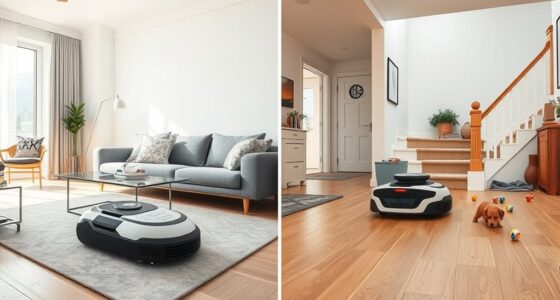
Over the next decade, household robots will become smarter, more personalized, and seamlessly integrated into your daily routines. They’ll learn your preferences, adapt to your habits, and work more intuitively thanks to advances in AI, sensors, and smart home connections. These robots will improve safety, handle chores efficiently, and foster more natural, emotional interactions. If you want to explore how these innovations will shape your family life and privacy, keep exploring what’s ahead.
Key Takeaways
- Household robots will become more personalized, learning user preferences and adapting behaviors for seamless daily assistance.
- Improved integration with smart home ecosystems will enable centralized, intuitive control of multiple devices.
- Advances in AI and sensor technology will enhance robots’ environmental awareness, safety, and obstacle recognition.
- Robots will develop empathetic interactions, strengthening human-robot relationships and emotional understanding.
- Ethical standards and privacy protections will remain central, ensuring responsible, secure, and trustworthy household automation.
The Rise of Intelligent Household Robots

As technology advances rapidly, intelligent household robots are becoming more common in everyday life. You’ll notice these robots handling chores, managing schedules, and even providing companionship. As they become more integrated, questions about robot ethics arise, especially around user privacy. These devices collect data to personalize your experience, but it’s essential to contemplate how that data is stored and protected. Ensuring your privacy isn’t compromised is a growing concern as robots gain more access to your home and routines. Manufacturers are working to develop transparent policies and secure systems to address these issues. Ultimately, the rise of these intelligent robots offers convenience while highlighting the importance of balancing technological benefits with responsible data handling and ethical considerations.
Enhanced Automation and Personalization

You’ll notice household robots become smarter, adapting to your routines with ease. Their customization capabilities mean they can tailor tasks specifically to your needs. As these robots learn over time, they’ll provide a more seamless and personalized living experience.
Smart Customization Capabilities
Smart customization capabilities are transforming household robotics by enabling devices to adapt seamlessly to your routines and preferences. With advanced voice recognition, your robots can understand your commands more accurately and respond naturally, making interactions feel effortless. They learn your user preferences over time, adjusting settings and behaviors to suit your lifestyle. For example, a robot vacuum might prioritize cleaning certain areas based on your schedule, or a smart assistant could tailor its notifications to your habits. This level of personalization guarantees your household devices become more intuitive and helpful, reducing the need for manual adjustments. As these capabilities improve, you’ll experience a more harmonious integration of robotics into your daily life, making routines smoother and more efficient.
Adaptive Learning Technologies
Adaptive learning technologies are revolutionizing household robotics by enabling devices to automatically refine their functions based on your behavior. With adaptive learning, your robotic companionship becomes more intuitive, adjusting to your routines and preferences over time. These robots analyze your interactions, optimizing cleaning schedules, entertainment choices, and even social engagement. As a result, your home feels more personalized and efficient. You’ll notice smarter responses from your devices, creating seamless automation. This technology enhances user experience by making robots more proactive and responsive. Expect robots to learn from your habits, improving their assistance without explicit reprogramming. Over the next decade, adaptive learning will deepen the bond between you and your household robots, fostering true companionship through continuous, self-directed improvement.
- Personalized routines based on daily habits
- Smarter task prioritization
- Improved emotional and social responsiveness
- Continuous self-improvement through learning
Integration With Smart Home Ecosystems
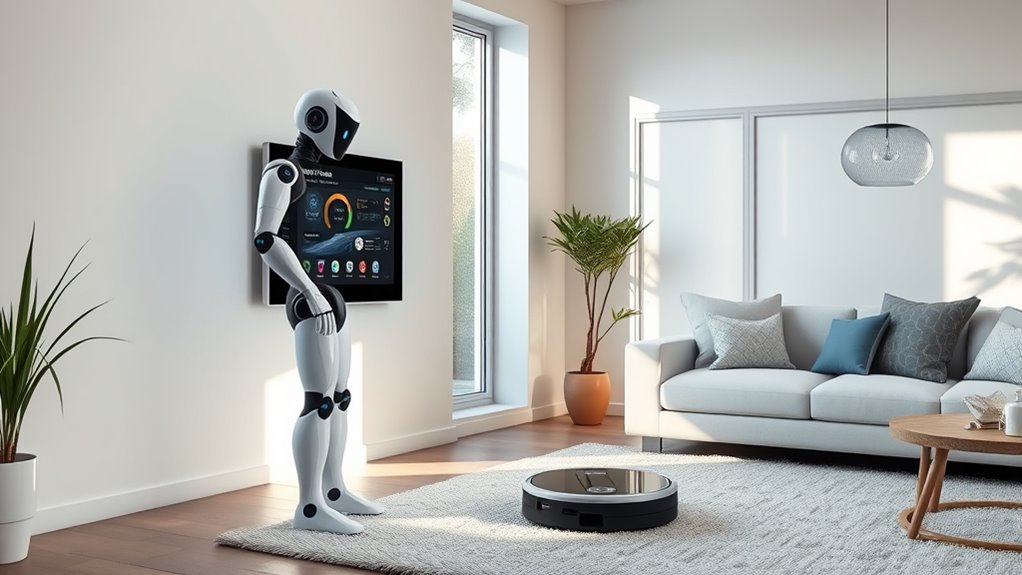
As household robots connect more seamlessly with smart home ecosystems, you’ll notice improved device coordination and smoother operation. Unified control platforms make managing everything from security to lighting easier and more intuitive. Enhanced interoperability standards guarantee these devices work together reliably, creating a truly integrated living environment.
Seamless Device Connectivity
Seamless device connectivity is essential for creating a truly integrated smart home environment. When your household robots easily connect with other devices, you can control everything effortlessly through voice command or simple device pairing. This smooth integration allows your smart home to respond instantly to your needs, enhancing convenience and efficiency.
To achieve this, focus on:
- Universal compatibility across devices and platforms
- Simplified device pairing processes
- Robust wireless communication protocols
- Smart automation that adapts to your routines
Unified Control Platforms
Unified control platforms serve as the central hub that integrates all your household devices and robots into a cohesive smart home ecosystem. With these platforms, you can effortlessly manage everything through simple voice commands or intuitive user interfaces. Instead of juggling multiple apps or remotes, you get a unified experience that streamlines automation and control. These systems connect your smart appliances, lighting, security, and household robots, enabling seamless interactions. You can adjust settings, monitor statuses, and trigger routines with ease. As these platforms evolve, they’ll become more intelligent, learning your preferences and optimizing household tasks. This integration guarantees your robots and devices work harmoniously, making your home more efficient and user-friendly without the need for complex setup or technical expertise.
Enhanced Interoperability Standards
Enhanced interoperability standards are the next step in creating truly integrated smart home ecosystems. These standards allow household robots to communicate seamlessly with various devices, improving overall functionality. With better integration, you’ll experience more sophisticated voice recognition, enabling robots to respond accurately to commands across platforms. This enhances user convenience and simplifies daily routines. Additionally, improved standards promote energy efficiency by coordinating devices to optimize power use, reducing waste. You’ll also benefit from consistent updates and compatibility, preventing fragmentation among devices. Overall, this leads to a smarter, more efficient home where your household robots work in harmony with smart appliances and security systems.
- Seamless device communication and control
- Improved voice recognition for accurate commands
- Coordinated energy management for efficiency
- Compatibility across diverse smart home platforms
Advances in Sensors and Perception Capabilities

Recent advances in sensors and perception capabilities are transforming household robotics by enabling these devices to better understand and navigate their environment. Sensor fusion combines data from cameras, LiDAR, and ultrasonic sensors, creating a thorough view of your home. Improved perception algorithms process this information efficiently, allowing robots to recognize objects, detect obstacles, and interpret spatial layouts accurately. This progress results in more reliable, responsive, and safe household robots.
| Sensor Type | Function | Advantage |
|---|---|---|
| Cameras | Visual recognition, mapping | Detailed environment data |
| LiDAR | Distance measurement, obstacle detection | Precise spatial awareness |
| Ultrasonic Sensors | Proximity sensing | Quick obstacle detection |
| Infrared Sensors | Night vision, proximity detection | Enhanced low-light sensing |
The Role of Artificial Intelligence and Machine Learning
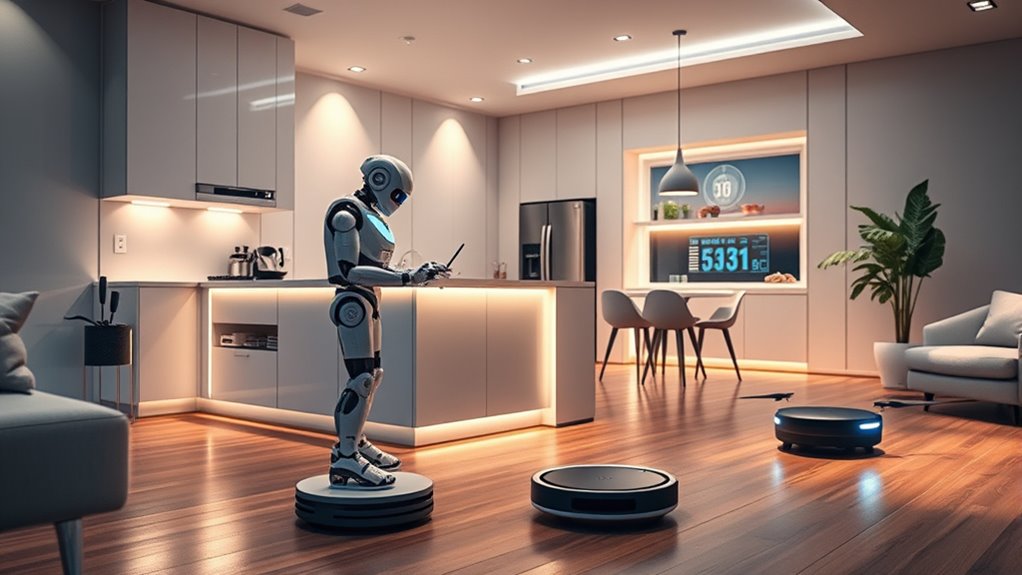
Artificial Intelligence (AI) and Machine Learning (ML) are revolutionizing household robotics by enabling devices to learn from their environment and adapt to new situations. With AI, your robot can recognize patterns, optimize tasks, and improve performance over time. Advanced ML algorithms allow robots to develop emotional intelligence, helping them better understand your needs and respond empathetically. This makes interactions more natural and personalized. As AI advances, ethical AI principles guide developers to create responsible, safe, and trustworthy robots. You’ll see smarter devices that not only perform chores but also foster a more intuitive and human-like relationship. Key ideas include:
AI and Machine Learning enable smarter, more empathetic household robots that learn, adapt, and build trustworthy human-like relationships.
- Learning and adapting to your routines
- Recognizing emotional cues
- Improving task efficiency
- Ensuring responsible AI development
Ethical Considerations and Privacy Concerns

As household robots become more integrated into daily life, ethical considerations and privacy concerns take center stage. You need to contemplate how data privacy is protected, especially as robots collect sensitive information about your routines and environment. Implementing robust ethical frameworks ensures responsible use of this data and prevents misuse. To help, here’s a quick overview:
| Concern | Action |
|---|---|
| Data Privacy | Use encryption and secure data storage |
| Ethical Frameworks | Establish clear guidelines for responsible AI use |
| User Control | Provide options to review, delete, or limit data use |
The Impact on Daily Living and Family Dynamics

How do household robots change the rhythm of daily life and family interactions? They can streamline chores, giving you more time for meaningful family moments. These robots often become part of daily routines, helping with tasks like cleaning, meal prep, or monitoring safety, which reduces stress and frees up your schedule. As a result, family communication can improve because you’re less overwhelmed and more present. However, reliance on robots might also shift dynamics, sometimes reducing face-to-face interactions or creating dependence. You may notice smoother routines but should stay mindful of maintaining genuine family connections.
- Automate household chores, freeing time for bonding
- Enhance safety and security, easing worries
- Impact family communication, either positively or negatively
- Change daily routines, creating new patterns
Frequently Asked Questions
Will Household Robots Be Affordable for Average Families in the Next Decade?
Yes, household robots will likely become affordable for average families within the next decade. As technology advances, cost reduction efforts will make these devices more accessible, driving market accessibility. You’ll see prices drop due to mass production and improved materials, allowing more households to benefit from robotics. By then, household robots will be a common, affordable addition to everyday life, simplifying chores and enhancing convenience for everyone.
How Will Robots Handle Emergencies or Unpredictable Household Situations?
Household robots will become better at emergency response and unpredictability management over the next decade. You’ll find they quickly assess situations, like fires or medical emergencies, and act accordingly. Advanced sensors and AI enable them to adapt to unpredictable household scenarios, providing immediate help or alerting you. This means you’ll feel safer, knowing your robot can handle emergencies efficiently, even when situations suddenly change or require quick thinking.
What Are the Long-Term Health Impacts of Relying on Robots for Daily Chores?
Relying on robots for daily chores can benefit your physical health by reducing strain and injury from repetitive tasks. However, it might impact your mental well-being if it limits social interactions or physical activity. To maintain a healthy balance, make certain you stay active and engaged beyond robotic assistance. Over time, this reliance could lead to decreased strength or mental stimulation, so monitor your habits to promote overall well-being.
Can Household Robots Develop Emotional Intelligence and Empathy?
Imagine your household robot as a friend who understands your feelings. While they can be programmed to recognize emotional cues and respond empathetically, true emotional awareness remains a challenge. Advances in AI are improving empathetic responses, but they lack genuine emotional depth. You’ll find robots increasingly capable of mimicking empathy, but their understanding is still limited, much like a mirror reflecting emotions rather than feeling them yourself.
How Will Regulations Evolve to Ensure Safe and Ethical Robot Use at Home?
Regulations will likely tighten around household robots, emphasizing privacy concerns and liability frameworks. You’ll see stricter rules on data collection and usage, ensuring your personal information stays secure. Manufacturers will face clearer liability guidelines, making them responsible for any harm caused by their robots. These evolving regulations aim to balance innovation with safety, giving you peace of mind while using household robots responsibly and ethically.
Conclusion
In the next decade, household robots will become smarter and more helpful, seamlessly fitting into your daily life. You might worry about privacy or job loss, but these advancements aim to enrich your routines and free up your time. With ongoing improvements, you’ll find these robots not just tools, but trusted companions that enhance your home experience—making life easier without sacrificing your privacy or independence. The future of home automation is truly exciting!