
TL;DR

Get home appliances delivered free with Prime
- Fast, free delivery on millions of items
- Prime Video, Amazon Music and more included
- Member-only deals all year
A report by Ideal Home says retrofitting insulation can help homes retain heat, but it is not a guaranteed way to lower heating bills. Experts quoted in the report caution that older buildings need assessment for wall construction and moisture management before insulation is installed.
Retrofitting insulation can help a home hold on to heat, but it may not automatically deliver lower bills, according to an Ideal Home report featuring advice from two building and energy specialists. The report says the right approach depends on how a property was built, particularly in older homes, where unsuitable materials or reduced ventilation can contribute to moisture and damp problems.
The report cites Becky Lane, chief executive of home retrofit company Furbnow, who says owners of older properties should establish their wall construction before choosing insulation. Traditional buildings, especially those built before the 1930s, may manage moisture by allowing it to pass through the walls. Making a home more airtight without enough ventilation could trap moisture inside, she warns.
Martyn Fowler, founder of Elite Renewables, says insulation can make a substantial difference in older houses that started with little insulation, but he cautions against treating all properties alike. A Victorian solid-wall home and a 1930s cavity-wall home have different construction and moisture needs, he says; a poorly chosen or installed system can contribute to damp in solid walls that need to dry out.
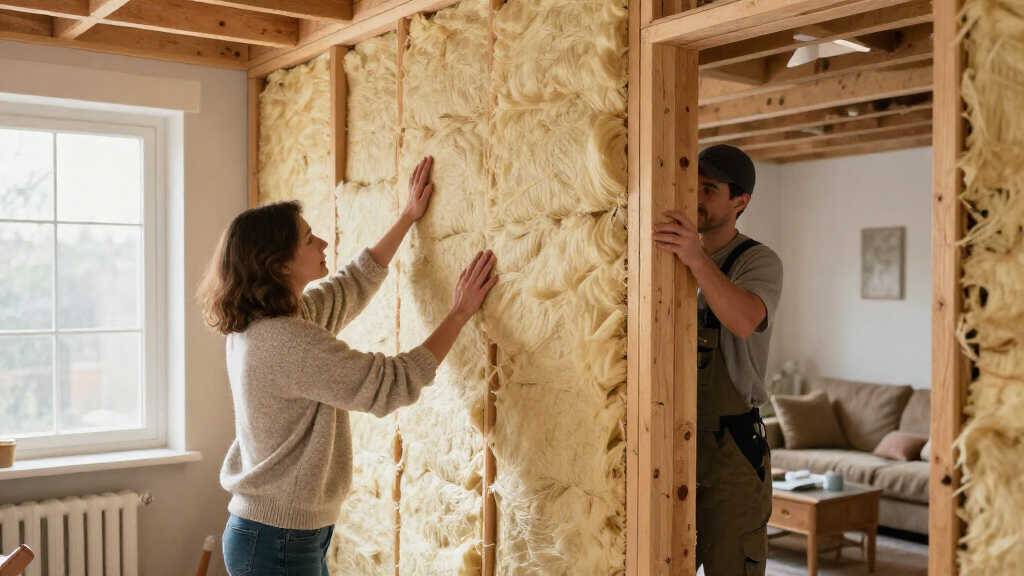
Disruption varies by method. The report describes loft insulation as relatively straightforward and says cavity-wall work may take two to four hours, with small holes drilled in external walls for the material to be injected and then repaired. Internal wall insulation is more intrusive: fixtures such as radiators, sockets and skirting boards may need moving, followed by wall finishing and redecoration. External insulation is installed from outside but can require scaffolding and adjustments around fittings and window reveals.
How Insulation Can Affect Bills
For households trying to stay warm while limiting heating use, insulation may reduce the rate at which heat escapes through a home’s walls or roof. That can make rooms more comfortable and may reduce the amount of heating needed, but the source report gives no measured bill savings, payback period or typical cost. It does not establish that every retrofit will lower a household’s bills.
The practical choice also matters. A relatively simple loft or suitable cavity-wall project may involve less disruption than insulating solid walls. By contrast, internal work can affect occupied rooms, and choosing a system without considering ventilation and moisture may create costly problems. The report’s central message is that homeowners should assess the building before treating insulation as a straightforward upgrade.
Products Worth Considering

Coway Airmega AP-1512HHS Smart Air Purifier, Black

Bose TV Speaker Compact Soundbar with Bluetooth and HDMI-ARC, Black

eufy Security E30 4K Indoor Pan and Tilt Camera, 2-Pack
As an affiliate, we earn on qualifying purchases.
Choosing Insulation for the Building
The article frames retrofit insulation as one possible response to heat loss and high household energy costs, rather than a single solution for every property. Its expert comments distinguish between insulation types and building designs: cavity walls have a space that may be filled, while solid-wall insulation is added to the inside or outside of the existing wall.
Fowler also identifies the condition of a wall, exposure to driving rain and whether a cavity is clear as factors to check before cavity-wall insulation. Floor insulation can depend heavily on access beneath suspended timber floors. The supplied report excerpt does not provide further details on floor installation or quantify the performance of any option.
“With an old house you really need to understand what you’re dealing with before you start.”
— Becky Lane, CEO of Furbnow
Savings and Suitability Vary
The source material does not state how much homeowners could save, what installation costs, or how long it might take for savings to offset those costs. Its headline question about lower bills is not answered with comparative figures or evidence from monitored homes, so the financial outcome for an individual property remains uncertain.
The report also does not provide a property-specific assessment, recommend a particular product, or set out detailed ventilation specifications. Whether cavity, internal, external, loft or floor insulation is appropriate depends on the home’s construction and condition. No claim is made that insulation alone will remove the need for heating.
Assess the Home Before Work
For homeowners considering a retrofit, the experts’ advice in the report points to checking wall construction, the condition and exposure of walls, cavity suitability, moisture behaviour and ventilation before choosing a system. The expected disruption should also be planned: internal work may be done room by room, while external insulation can require scaffolding and changes around fittings.
The source material does not announce a new scheme, deadline or follow-up study. Any decision about costs, likely savings and installation should be based on an assessment of the specific property; the report’s broad guidance does not settle those questions for individual homes.
Key Questions
Can retrofitting insulation lower heating bills?
It may help reduce heat loss and the amount of heating a home needs, but the report provides no figures for typical savings or costs. The effect depends on the property and the insulation work.
Why do older houses need extra care?
Some older buildings manage moisture by allowing it to pass through walls. Lane and Fowler warn that unsuitable insulation or making a home more airtight without adequate ventilation can trap moisture and contribute to damp.
Which insulation work is least disruptive?
The report describes loft insulation as relatively straightforward. Suitable cavity-wall insulation may take two to four hours, while internal wall insulation generally involves more work inside rooms and redecoration.
What should be checked before cavity-wall insulation?
Fowler says homeowners should check the condition of the walls, exposure to driving rain and whether the cavity is clear. The source also stresses that the property must be suitable for the proposed system.
Source: idealhome.co.uk