
TL;DR

Get home appliances delivered free — and shop member deals
- Fast, free delivery on millions of items
- Access to Prime Big Deal Days deals on October 6–7
- Prime Video, Amazon Music and more included
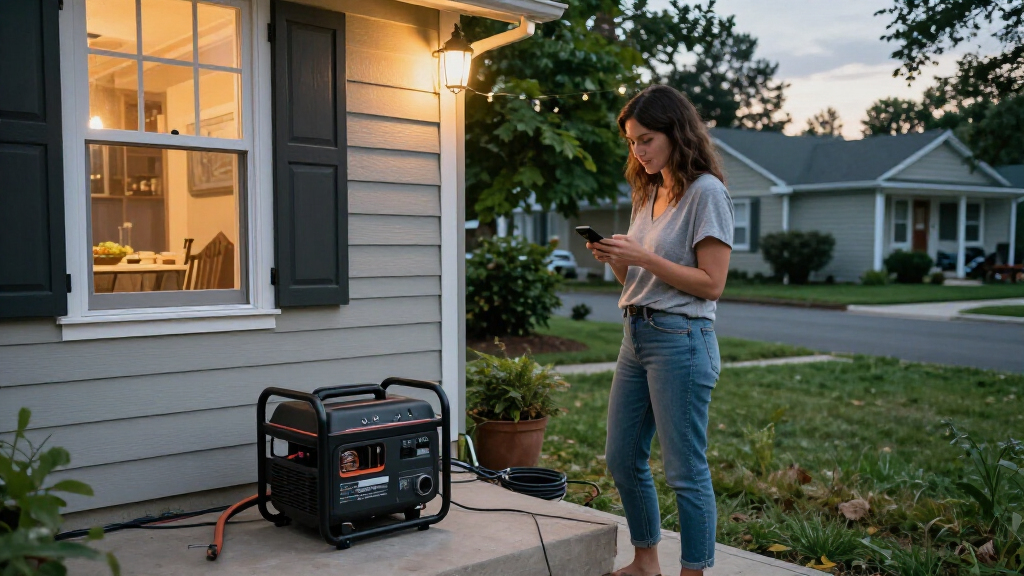
Family Handyman reviewer Paul Rankin tested the Anker Solix Smart Generator 5500 for just over a month with gasoline and propane, including a connection to an Anker Solix E10 home battery system. He reported easy setup and app-based operation, with DC output reaching about 4.5 kW; noise, ecosystem cost and untested natural-gas operation remain caveats.
Family Handyman reviewer Paul Rankin reported that the Anker Solix Smart Generator 5500 was easy to set up and operate during just over a month of testing with gasoline and propane at his Florida home. He also connected it to an Anker Solix E10 home battery system, where the generator supplied charging power while the batteries powered the house—a setup relevant to homeowners weighing backup options for extended outages.
Rankin tested manual and app-based starting, Eco and higher-output modes, portability, noise and charging through the E10. He said setup took about 20 minutes, including connecting the startup battery and adding engine oil. Both the physical start control and Anker app worked during his tests, and a manual pull start is available as a backup. He reported no starting problems, overloads, connection failures or app glitches during the month of use.
The generator can run on gasoline, propane or natural gas. Family Handyman lists up to 4,500 watts of DC output on gasoline or propane and 4,000 watts on natural gas. For AC use, the unit provides up to 3,600 rated watts across a NEMA TT-30R and a NEMA 5-20R outlet. Rankin said he observed DC charging output of about 4.5 kW in testing.
In the tested home setup, the generator did not directly power every household appliance. It charged the E10, whose batteries supplied the home’s electrical loads. Rankin said the battery system could use generator power to serve current demand and store additional energy when output exceeded that demand. His longest continuous generator test lasted about two hours.
How the Battery Changes Backup Power
The review’s main finding concerns how the generator works with a home battery. A conventional generator can power compatible loads directly, while the tested Anker arrangement used the generator to recharge the E10 and let the battery system manage household supply. That gives a homeowner another charging source when rooftop solar cannot keep up, including after dark, according to Rankin’s account.
The distinction matters when evaluating the reviewer’s description of whole-home support: the generator’s role was to provide up to roughly 4.5 kW of DC charging power, while the batteries handled the home’s actual loads. Readers should not interpret the test as evidence that the generator alone directly ran every appliance in the home.
The system also comes with a substantial cost beyond the generator. Rankin said his E10 battery equipment cost around $14,000, with professional installation adding about $4,500. Those are costs for his setup, not a universal estimate, but they show why the generator’s value depends partly on whether a buyer already owns compatible Anker equipment or plans to invest in the broader system.
A Florida Home Backup Test
Rankin conducted the review at his Florida home, which already had rooftop solar and an Anker Solix E10 whole-home battery system. His installation included two E10 power modules and three battery expansion modules. Electricians Arcenio Garcia of Firstline Electric & Energy and Oswin Fernandez of Future Electric Solutions performed the system installation, according to the review.
The generator is a 224cc, four-stroke portable inverter model. Its direct DC output is designed to connect with compatible Anker equipment, avoiding conversion from generator AC power back to DC for charging. The E10 is designed to accept up to 4,500 watts of DC generator input. An E10 is not required to use the generator, though Rankin considered the integration its strongest selling point.
The review’s headline says the writer will never lose power again, but the testing described does not establish that outcome. It records a month of use under test conditions, including one continuous run of about two hours, rather than performance through a prolonged real-world outage.
“The biggest surprise was how easy Anker made practically everything about using a gas-powered generator.”
— Paul Rankin, Family Handyman reviewer
Natural Gas and Longer Outages Untested
Rankin did not test natural-gas operation. He said connecting it to his home’s gas supply would require a professionally installed connection, which he planned to add later. The review therefore does not report hands-on results for that fuel.
The longest continuous test lasted about two hours, so the material does not show how the generator performs over several days of sustained outage use. It also does not give a measured noise level or a full comparison with other generators. Rankin described the generator as noisy, but readers are not given a decibel figure in the supplied review material.
The costs reported for the E10 equipment and installation describe the reviewer’s own system. The review material does not establish a complete cost for every possible configuration or how results would vary with different household loads, solar production or battery capacity.
Planned Natural Gas Connection
Rankin said he plans to add a professionally installed natural-gas connection and test the generator on that fuel. That would address one of the review’s main gaps. Until those results are reported, the hands-on findings apply to the tested gasoline and propane operation and the specific E10 setup at his home.
Homeowners considering a similar arrangement can compare the generator’s fuel options and output with their own backup needs, while accounting for the separate battery and installation costs described in the review. The available material does not give a date for Rankin’s planned natural-gas test or report results from a longer outage.
Key Questions
What did the Family Handyman reviewer test?
Paul Rankin tested the Anker Solix Smart Generator 5500 for just over a month with gasoline and propane. He also tried manual and app-based starts, operating modes, portability, noise and connection to a Solix E10 battery system.
Did the generator directly power the whole house?
In Rankin’s test, the generator supplied DC power to charge the E10 battery system. The batteries, rather than the generator directly, powered the home’s electrical loads.
How much output did the generator provide?
The review lists up to 4,500 watts of DC output on gasoline or propane and 4,000 watts on natural gas. It lists up to 3,600 rated watts of AC output on all three fuels. Rankin observed about 4.5 kW of DC charging output during testing.
Did the reviewer test natural gas?
No. Rankin said a connection to his home’s gas supply would need professional installation and that he planned to add one in the future. The review gives no natural-gas test results.
How much did the reviewer’s battery setup cost?
Rankin reported about $14,000 for the E10 battery equipment and approximately $4,500 for professional installation. Those figures describe his setup; the supplied material does not establish a total cost for every buyer.
Source: rss
Fall Picks
fall essentials
As an affiliate, we earn on qualifying purchases.