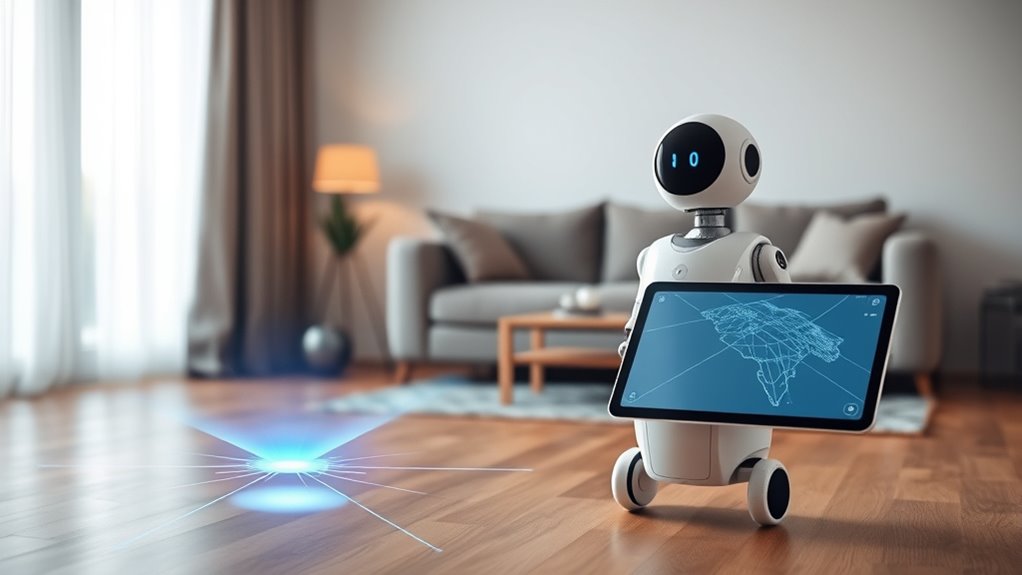

A home robotics glossary covers key terms like LIDAR, which uses lasers for precise mapping, and SLAM, a method for robots to build maps while locating themselves. You’ll also learn about sensors such as infrared, ultrasonic, and cameras that help robots detect obstacles and navigate. Understanding path planning algorithms like A* aids in efficient movement around your home. Exploring these terms will deepen your knowledge of how smart robots operate and adapt in your environment.
Key Takeaways
- LIDAR uses laser sensors to create detailed 3D maps of surroundings for precise navigation.
- SLAM enables robots to build maps while simultaneously tracking their location within the environment.
- Path planning algorithms like A* determine optimal routes avoiding obstacles based on environment data.
- Sensor fusion combines data from infrared, ultrasonic, and visual sensors to improve environmental understanding.
- Advanced sensors allow home robots to operate safely, efficiently, and adapt to dynamic household environments.
Ever wondered what terms like “LIDAR” or “SLAM” mean when it comes to home robots? These are vital concepts that help your robot move around your house efficiently and safely. At the heart of this technology are different robot sensor types, which gather essential information about the environment. These sensors include infrared, ultrasonic, bump sensors, and cameras, each serving a specific purpose. Infrared sensors detect nearby objects through light signals, ultrasonic sensors use sound waves to measure distances, bump sensors alert the robot when it physically contacts something, and cameras provide visual data. By combining these sensors, your robot can build a detailed picture of its surroundings, enabling smarter navigation.
Robot sensors like infrared, ultrasonic, bump sensors, and cameras enable smart, safe home navigation.
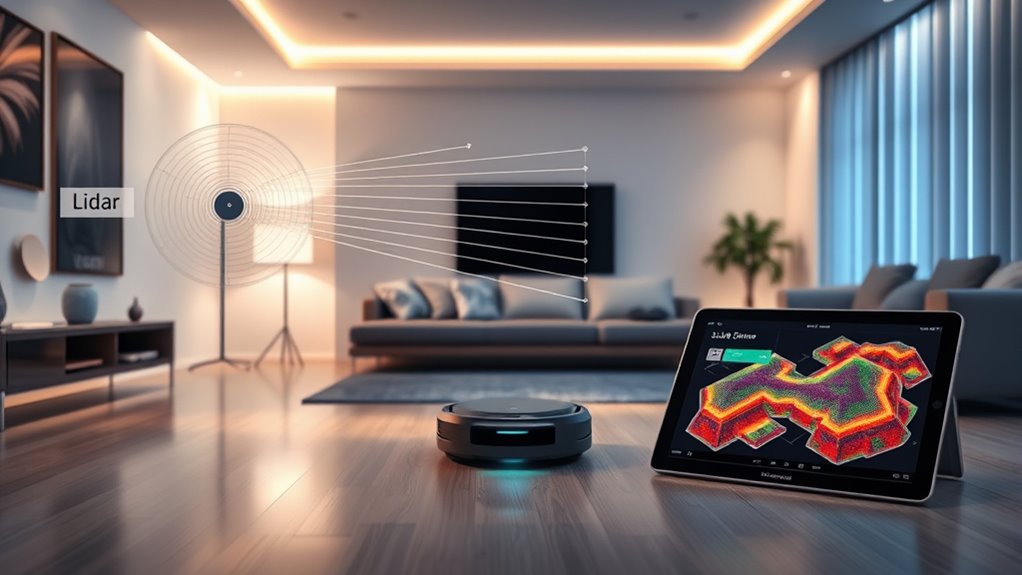
This is where autonomous navigation techniques come into play. These techniques allow your robot to determine its position, avoid obstacles, and plan paths without human intervention. A common method is SLAM, or Simultaneous Localization and Mapping. With SLAM, your robot creates a map of your home while keeping track of its own location within that map. It processes data from sensors like LIDAR, which uses laser beams to measure distances precisely. LIDAR provides a detailed 3D view of the environment, making it easier for the robot to detect furniture, walls, and other obstacles. Using this information, the robot can navigate complex layouts seamlessly. Understanding the contrast ratio of your robot’s sensors and display can also be crucial in low-light or high-contrast environments.
Another popular autonomous navigation technique involves algorithms like A* or Dijkstra’s algorithm, which help your robot find the shortest and safest paths through your home. These algorithms analyze the map generated by SLAM and determine the best route to reach a target location—say, from the charging station to the living room. Additionally, obstacle avoidance systems are integrated into these methods. They allow the robot to react instantly if an unexpected object appears in its path, stopping or rerouting to prevent collisions.
In essence, understanding robot sensor types and autonomous navigation techniques helps you grasp how your home robot operates. They work together to guarantee your device moves accurately, avoids hazards, and performs its tasks efficiently. Whether it’s vacuuming your floors or delivering items, these technologies create smarter, more reliable robots that adapt to your home environment. So next time your robot whizzes around, remember it’s relying on complex sensor systems and advanced navigation strategies to do its job seamlessly.
Frequently Asked Questions
How Do Home Robots Learn to Navigate Unfamiliar Spaces?
You can help home robots navigate unfamiliar spaces by understanding that they use robot learning algorithms and sensor fusion techniques. These systems process data from sensors like cameras and Lidar, allowing the robot to map and adapt to new environments. As you interact with them, they improve their understanding, making navigation more accurate. This combination of algorithms and sensor integration enables robots to explore, learn, and operate efficiently in unfamiliar areas.
What Is the Difference Between SLAM and GPS for Mapping?
SLAM and GPS are both used for robot mapping and localization, but they differ considerably. SLAM (Simultaneous Localization and Mapping) helps your home robot build a map and locate itself using sensors like Lidar, perfect for indoor environments. GPS provides global positioning data, which isn’t reliable indoors. You’ll find SLAM essential for steering through unfamiliar spaces, while GPS is better suited for outdoor mapping and large-scale localization.
Are Lidar Sensors Safe for Indoor Use Around Humans?
Lidar sensors are safe for indoor use around humans when properly calibrated, ensuring accurate readings and minimal interference. They emit laser pulses that are harmless at typical operating levels, but you should regularly perform sensor calibration to maintain safety and performance. Privacy concerns are minimal since lidar doesn’t capture detailed images like cameras, but it’s good to be aware of data storage and usage policies to protect your privacy.
How Do Robots Recognize and Avoid Obstacles Efficiently?
Think of a robot as a vigilant eye, constantly scanning and adapting. You can see how it recognizes and avoids obstacles through sensor fusion, combining data from cameras, lidar, and ultrasonic sensors. This layered approach enhances obstacle detection, allowing the robot to navigate efficiently. By analyzing real-time inputs and predicting potential collisions, it seamlessly steers clear of obstacles, like a skilled dancer avoiding hurdles on a crowded stage.
Can These Robotics Technologies Be Integrated With Smart Home Systems?
Yes, you can integrate robotics technologies with your smart home systems. By using voice command integration, you can control your robot and automate tasks effortlessly. Additionally, these systems help optimize energy efficiency by coordinating device operation and avoiding unnecessary energy use. This seamless integration makes managing your home more convenient, efficient, and responsive to your needs, enhancing your everyday living experience.
Conclusion
Understanding home robotics terms like LiDAR and SLAM helps you better grasp the technology transforming your living space. Did you know that the home robotics market is projected to reach $4.4 billion by 2026? As these devices become smarter and more affordable, you’ll find yourself more connected and efficient at home. Keep learning these terms, and you’ll stay ahead in the ever-evolving world of home automation and robotics.