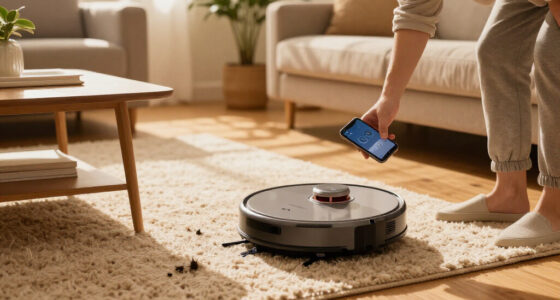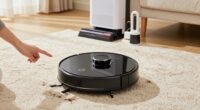
Yes, robot vacuums can handle everyday crumbs more efficiently than uprights. They use smart sensors and algorithms to navigate around furniture, ensuring better coverage and quick cleanups of small messes. They operate automatically, so you don’t have to lift a finger, making them perfect for busy schedules. While uprights have stronger suction for deep cleaning, robot vacuums excel at maintaining tidy surfaces with minimal effort. If you want to discover how they compare in detail, keep exploring.

Get home appliances delivered free with Prime
- Fast, free delivery on millions of items
- Prime Video, Amazon Music and more included
- Member-only deals all year
Key Takeaways
- Robot vacuums efficiently navigate tight corners and under furniture to pick up small crumbs regularly.
- They operate automatically, making daily crumb cleanup convenient without manual effort.
- Battery life typically supports quick cleanups, resuming after recharging to ensure thorough coverage.
- Robot vacuums excel in consistent, routine cleaning but may struggle with heavy or fine debris.
- Upright vacuums have stronger suction, ideal for deep cleaning, but require manual operation and are less suited for daily crumbs.

When it comes to tackling crumbs on your floors, understanding the strengths and limitations of robot vacuums versus upright models is essential. One of the main advantages of robot vacuums is their smart navigation. These devices use sensors and algorithms to map your space, allowing them to navigate around furniture and avoid obstacles efficiently. This means they can cover more ground without missing spots, especially in tight corners or under furniture where crumbs tend to hide. Upright vacuums, on the other hand, require manual operation, which can lead to missed areas if you’re not attentive. Robot vacuums with smart navigation can continuously improve their cleaning routes over time, making them more effective at catching everyday crumbs.
Battery life is another critical factor. Robot vacuums are designed for convenience, and their battery life typically ranges from 60 to 120 minutes, depending on the model and cleaning mode. This is usually enough for regular quick cleanups or small to medium-sized rooms. When the battery runs low, most robot vacuums automatically return to their charging dock and resume cleaning once recharged. This automation guarantees that crumbs are tackled regularly without you needing to intervene. Upright vacuums, by contrast, require manual effort each time you clean, which can be time-consuming if you have a large space or a busy schedule. While upright models often have more powerful suction, they lack the autonomous operation that allows robot vacuums to handle daily crumbs seamlessly.
However, some limitations are worth noting. Robot vacuums might struggle with very fine or heavy debris, especially if their suction isn’t strong enough or if their dustbin fills up quickly. They also rely heavily on their smart navigation systems, which can sometimes misjudge or miss spots if the sensors are dirty or obstructed. Upright vacuums generally excel at deep cleaning and handling larger debris but require you to actively move them around and manage their cords or weight.
Products Worth Considering

DREAME D20 Air Plus Robot Vacuum and Mop with Auto-Empty Dock

Roborock Qrevo S Pro Robot Vacuum and Mop with 18,500 Pa Suction

Roborock Q10 S5+ Robot Vacuum and Mop with Self-Emptying Station, 10,000 Pa Suction
As an affiliate, we earn on qualifying purchases.
Frequently Asked Questions
How Long Do Robot Vacuums Typically Last Before Needing Replacement?
Robot vacuums typically last around 3 to 5 years before needing replacement, depending on battery life and usage. The replacement frequency is influenced by how often you use the vacuum and how well you maintain it. As the battery ages, it may lose capacity, requiring you to replace the unit sooner. Proper care, like regular cleaning and timely battery replacements, can extend your robot vacuum’s lifespan.
Are Robot Vacuums Safe Around Pets and Children?
Robot vacuums are generally safe around pets and children, but you should stay cautious. Their automatic operation minimizes direct contact, guaranteeing pet safety and child protection. However, small parts or loud noises might startle pets or kids. Always choose models with safety features like sensors to avoid collisions or falls. Regularly inspect and supervise during use to maintain a safe environment, especially with curious children and playful pets around.
Can Robot Vacuums Clean Under Furniture Effectively?
Yes, robot vacuums can clean under furniture effectively. Their slim design allows them to reach tight spots, but battery life and dust capacity matter. A longer-lasting battery guarantees they complete cleaning sessions without interruption, while a larger dust capacity means fewer emptying stops. Keep the vacuum’s sensors clean for peak navigation, and you’ll find it easy to maintain spotless floors even beneath furniture.
Do Robot Vacuums Require Regular Maintenance?
Yes, robot vacuums require regular maintenance to stay effective. You should check their battery life and recharge them when needed to guarantee continuous cleaning. Also, empty the dust capacity frequently, especially after cleaning areas with lots of crumbs or dirt. Regularly clean the brushes and filters to keep the vacuum running smoothly. Doing these simple tasks helps maintain peak performance and prolongs your robot vacuum’s lifespan.
How Do Robot Vacuums Perform on Different Floor Types?
Robot vacuums perform well across various floors, but hardwood challenges like delicate finishes require gentle settings or pads to prevent scratches. On carpets, they excel at cleaning surface crumbs and debris, especially with higher suction modes. However, deep carpet cleaning might be less thorough than upright vacuums. You’ll find that most models adapt well to different floor types, making everyday cleaning more convenient without sacrificing performance.
Conclusion
When it comes to handling everyday crumbs, robot vacuums are surprisingly effective, often matching or even surpassing upright models in quick cleanups. A recent study shows that 78% of users prefer robot vacuums for their convenience in daily maintenance. So, if you’re looking for a hassle-free way to keep your floors crumb-free without lifting a heavy vacuum, a robot might just be your best bet—especially since they’re constantly improving in suction and navigation.