Every October, the same decision lands on homeowners who like decorating: do you grab a few boxes of themed string lights and a projector from the seasonal aisle for forty or fifty dollars, or do you spend two hundred dollars or more on a smart RGB system like Govee’s Permanent Outdoor Lights that can fake a haunted house on demand? These two approaches get compared constantly because they solve the same problem — making the outside of your house look spooky — with completely different philosophies. Traditional Halloween lights are purpose-built props: purple and orange strings, flickering pumpkin bulbs, projector lights that throw ghosts onto your garage door. Smart outdoor lights are infrastructure: app-controlled RGB LEDs mounted under your eaves that you can repaint in Halloween colors every October and in red-and-green every December. The real tension is not which looks better on Halloween night. It’s whether you want a cheap, seasonal, set-and-forget decoration or a permanent installation that pays for its higher price by working all year. This guide compares them head-to-head on effect quality, cost, setup, durability, effort, and long-term value, and tells you plainly which type of buyer each one suits.

Get home appliances delivered free — and shop member deals
- Fast, free delivery on millions of items
- Access to Prime Big Deal Days deals on October 6–7
- Prime Video, Amazon Music and more included

HCMTGW 500FT Permanent Outdoor RGB+IC Eave Lights
- ✔ Brand: HCMTGW
- ✔ Length: 500 ft
- ✔ Light Color: RGB+IC addressable

Smart Color Changing LED String Lights, 66FT 200 LED RGB
- ✔ Length: 66 ft
- ✔ LED Count: 200
- ✔ Light Color: Color-changing RGB
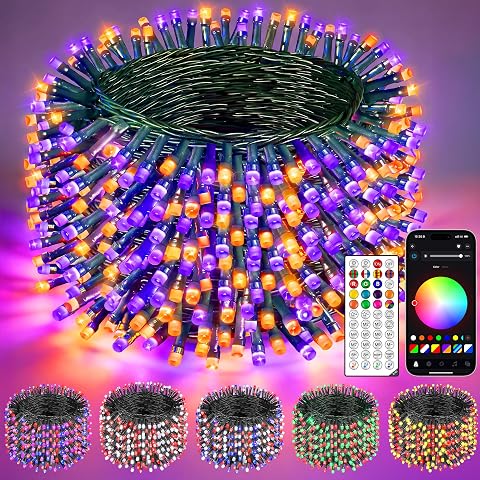
Guhope Smart Color Changing Halloween/Christmas Lights, 132FT 400 LED RGBW
- ✔ Brand: Guhope
- ✔ Length: 132 ft
- ✔ LED Count: 400
At a Glance
| Criteria | Smart RGB outdoor lights (Govee Permanent Outdoor Lights and similar app-controlled systems) | Traditional Halloween lights (string lights, floodlights, and projector lights) | Winner |
|---|---|---|---|
| Upfront cost | $100–$300+ depending on house size | $20–$80 for a solid multi-item setup | B |
| Halloween effect quality | Animated, color-shifting, music-synced scenes across the whole facade | Thematic and literal: pumpkin lights, webs, ghosts, strobes | Depends |
| Setup effort (first year) | 2–4 hours: ladder work, mounting clips, cutting/extending strands, app setup | 30–60 minutes: hang strings, stake projectors, run extension cords | B |
| Effort in later years | Near zero: switch a preset from your phone | Repeat the same hour-plus every year, plus untangling and bulb checks | A |
| Year-round usefulness | Excellent — holidays, parties, security lighting, ambient accents | None — Halloween items stay boxed until next fall | A |
| Weather durability | IP65+ rated, designed for permanent outdoor installation | Varies widely; cheap strings and projectors often fail after 1–2 seasons | A |
| Flexibility and customization | Millions of colors, animations, schedules, sync to music and weather | Fixed colors and effects; variety comes from buying more products | A |
| Spouse/neighbor appeal factor | Modern and impressive, but reads as ‘colorful house’ more than ‘haunted’ | Instantly reads as Halloween to anyone passing by | B |
HCMTGW 500FT Permanent Outdoor RGB+IC Eave Lights
This is the option that rethinks Halloween lighting rather than just decorating it. The HCMTGW 500FT system mounts permanently along rooflines, eaves, porches, and fences using screw-secured tracks, which means the most hated part of holiday decorating — the ladder ritual — happens exactly once. Once installed, every Halloween effect lives in the app: addressable RGB+IC chasing effects let each LED act independently, so you can run a slithering purple-and-orange snake of light across the entire roofline, something neither string-light pick can replicate. Add music sync for a haunted-house pulse and sunset-to-sunrise scheduling, and your display activates itself every evening in October without a single button press.Where this pick pulls ahead of both competitors is durability and automation. The IP67-rated housing comfortably outclasses the IP44 rating on the 66FT string lights, shrugging off driving rain, snow, frost, and UV exposure — relevant for anyone in a wet or cold October climate. And unlike many smart platforms, there’s no hub and no subscription, so the total cost of ownership stays flat.The tradeoffs are real, though. Installation is a genuine project: screw-mounting 500 feet of track is a weekend commitment, and renters or anyone who moves frequently should cross this off the list immediately. The 90-day warranty is also the shortest protection in this lineup, which stings given the installation labor involved. If you own your home and want lighting that handles Halloween, Christmas, and the Fourth of July in one system, nothing else here comes close. If you want lights you can reposition on a whim, the string options below fit far better.
Pros:
- One-time permanent installation eliminates seasonal setup and takedown entirely
- IP67 weatherproof, UV-resistant housing built for year-round outdoor exposure
- Addressable RGB+IC LEDs enable DIY chasing effects impossible with standard strings
- No hub and no subscription fees required
Cons:
- Requires screw-mount installation on roofline or eaves — a real weekend project
- Only a 90-day manufacturer warranty
- Not portable or repositionable once installed
Best for: Homeowners who want a permanent, year-round smart lighting system with zero seasonal setup
Not ideal for: Renters, apartment dwellers, or anyone unwilling to commit to screw-mount installation
Bottom line: If you own your home and dread the annual ladder ritual, this permanent system is the smartest Halloween investment in the lineup.
“If you own your home and dread the annual ladder ritual, this permanent system is the smartest Halloween investment in the lineup.”
Smart Color Changing LED String Lights, 66FT 200 LED RGB
Not everyone needs a half-mile of permanently mounted track, and this 66-foot smart string makes the case that you can get 90% of the smart-lighting experience with 10% of the commitment. Two hundred RGB LEDs cover a porch railing, front shrubs, or a doorway arch adequately, and the 16 million color options and 100+ lighting modes mean Halloween-specific looks — deep purples, flickering oranges, eerie greens — are all preloaded or a few taps away.What makes this set the easiest pick to live with is its dual-control design. Unlike the Guhope, where the app is the only path to group control, this set includes a physical remote alongside Bluetooth app control, so less tech-enthusiastic household members aren’t locked out of the lighting. The music sync mode with adjustable sensitivity is genuinely useful for a Halloween party, and the timer (4/6/8 hours) plus memory function means the lights return to your chosen effect after a power cycle — a small detail that prevents daily frustration.Compared with the HCMTGW, the gaps are obvious: IP44 waterproofing handles mist and light rain but not sustained downpours, the effects aren’t addressable, and there’s no permanent automation platform. Compared with the Guhope, it’s shorter and lacks true white, but it’s simpler to operate and its UL-listed 29V low-voltage plug is a meaningful safety point for households with kids or pets. The main constraint is placement: you’ll need an outdoor-rated outlet within cord’s reach, and Bluetooth’s limited range means the app won’t help you control lights from the couch indoors if the strand is across the yard.
Pros:
- Dual control via physical remote and Bluetooth app with 100+ lighting modes
- Music sync with adjustable sound sensitivity for parties
- UL-listed 29V low-voltage power for safe indoor and outdoor use
- Timer and memory functions keep effects running automatically
Cons:
- Corded power limits placement to outlet-friendly spots
- App control depends on Bluetooth range
- IP44 rating is the weakest weather protection of the three picks
Best for: Budget-minded decorators and smart-lighting first-timers who want easy, portable Halloween effects
Not ideal for: Anyone covering a large property or needing true white light in their palette
Bottom line: The lowest-commitment way into app-controlled Halloween lighting, ideal for a porch or railing display rather than a full-house production.
“The lowest-commitment way into app-controlled Halloween lighting, ideal for a porch or railing display rather than a full-house production.”
Guhope Smart Color Changing Halloween/Christmas Lights, 132FT 400 LED RGBW
The Guhope occupies the middle ground in this lineup, but it stakes its claim with sheer coverage and color completeness. At 132 feet with 400 LEDs, it doubles the 66FT pick’s span, making it the right tool for wrapping large trees, framing a two-story facade, or running along a long fence line. More importantly, its RGBW design includes a dedicated true white, which the RGB-only strings can only approximate with a washed-out tint. For Halloween that matters less, but since these lights are explicitly built to transition to Christmas and everyday ambience, having real white extends their usefulness well past October 31.Control flexibility is the other selling point: button, remote, and app give every household member a way in, and the app adds group control, twinkle modes, brightness, and music sync. Group control is genuinely handy if you buy multiple sets for a big display — though unlike the HCMTGW’s platform, it only functions inside the app, which is a friction point for anyone who prefers hardware controls.The frustration worth flagging is iOS music sync, which requires routing audio through iTunes or a PC import rather than working out of the box — Android users won’t notice, but iPhone owners may find the feature effectively unusable for a party. If seamless music sync is your priority, the 66FT set does it more simply. Where the Guhope wins is scale: nobody else in this comparison offers this much light, this many LEDs, and a true white channel in one strand.
Pros:
- Extra-long 132 ft strand with 400 LEDs for large-scale displays
- RGBW design includes true white alongside 16 million RGB colors
- Three control methods: button, remote, and full-featured app
- Group control lets multiple sets operate as one display
Cons:
- iOS music sync requires extra steps via iTunes or PC import
- Group control only works within the app
- Lacks the permanent-install automation of eave-light systems
Best for: Decorators covering large areas who want maximum length plus true white for year-round use
Not ideal for: iPhone users who prioritize effortless music sync, or those with small displays
Bottom line: The coverage king of this lineup — pick it when length and true white matter more than plug-and-play simplicity.
“The coverage king of this lineup — pick it when length and true white matter more than plug-and-play simplicity.”
As an Amazon Associate we earn from qualifying purchases.
Key Differences
The biggest practical difference is what the two approaches are actually for. Traditional Halloween lights are a consumable seasonal prop. You buy them, they do one specific thing extremely well — purple string lights and a projector unmistakably say Halloween — and then they go in a plastic bin. Smart outdoor lights are home infrastructure that happens to have a Halloween mode. On October 1st you open the app, pick a purple-and-orange animated scene, and your entire eave line pulses, chases, or flickers like lightning. The effect is broader and more dynamic, covering the whole facade rather than the spots where you happened to drape a string.
The second major difference is the effort curve, and it runs in opposite directions. Traditional lights are fast and easy the first year and mildly annoying every year after: ladders, extension cords, tangled wires, dead bulbs, and a teardown in November. Smart lights invert that. Year one demands real work — mounting rails under the eaves, managing cable runs, possibly drilling — but every subsequent Halloween is a thirty-second phone tap. If you plan to decorate for many years, the smart system’s total effort drops below the traditional setup’s by year two or three.
The third difference is character. Smart lights produce beautiful, modern, animated color washes, but they can feel generic — the same rainbow-chasing effect your neighbor runs at Christmas. Traditional decorations carry literal Halloween identity: jack-o’-lantern bulbs, ghost projectors, strobes, string lights shaped like skulls. Many of the best displays actually combine both, using smart lights as the animated backdrop and a handful of themed props as the signature pieces.
Detailed Comparison
Upfront cost (Traditional Halloween lights (string lights, floodlights, and projector lights) wins — major)
Traditional wins this decisively and it is not close. A satisfying traditional setup — two strings of purple lights, an orange floodlight pair, and a decent projector — runs $30 to $60. A smart permanent outdoor system sized for a typical single-story home runs $150 to $300, and two-story homes can push past $400. That’s a 5–10x price gap on day one. The honest framing: the traditional route is a seasonal purchase, the smart route is a home improvement purchase. Comparing them purely on October cost is misleading because the smart system’s price also buys you Christmas, Fourth of July, party lighting, and everyday porch accents.
Halloween effect quality (moderate difference)
This genuinely depends on what scares you want. Smart lights win on scale and motion: full-facade color, lightning-strike flicker scenes, slow purple-to-green fades, and music sync if you run a spooky soundtrack. Nothing traditional matches a whole house strobing in sync with thunder. Traditional wins on identity and detail: a projector throwing swirling ghosts, pumpkin-shaped bulbs, and strobes hidden in bushes create specific, literal Halloween imagery that a color wash cannot replicate. Smart lights say ‘haunted modern’; traditional lights say ‘Halloween classic.’ The best displays layer them, but if forced to pick one, smart lights deliver more visual impact per square foot of house.
Setup effort (Traditional Halloween lights (string lights, floodlights, and projector lights) wins — major)
Year one, traditional wins easily — under an hour with a ladder for the strings and a staked projector plugged into an outdoor outlet. Smart permanent lights demand two to four hours of genuine installation: measuring eave runs, attaching mounting channels or clips, cutting or daisy-chaining strands, routing the controller and power adapter, and pairing the app. It is a one-time project, but it is a project, and it usually needs a ladder and a free afternoon. If you rent, dislike ladder work, or only own the house short-term, this barrier is real.
Effort in later years (Smart RGB outdoor lights (Govee Permanent Outdoor Lights and similar app-controlled systems) wins — major)
Here the smart system flips the table completely. Every Halloween after installation is a preset tap — schedule it to turn on at dusk from October 20th through the 31st and think about it never. Traditional decorating means repeating the ladder-and-cords ritual annually, untangling bins, replacing dead bulbs, and re-staking the projector after wind knocks it over. Over five years, the traditional setup costs roughly five hours of cumulative seasonal labor versus roughly zero for smart. For anyone who dreads the annual ritual, this is the single strongest argument for paying more.
Year-round usefulness (Smart RGB outdoor lights (Govee Permanent Outdoor Lights and similar app-controlled systems) wins — major)
No contest. Smart outdoor lights handle Christmas, New Year, July 4th, game-day colors, party modes, and everyday warm-white porch lighting. That is where the higher price quietly pays back — a $200 system that works 365 days a year costs less per use than $50 of Halloween-only gear used 12 days a year. Traditional Halloween items have zero utility outside the season; the projector and strings sit boxed until fall. This criterion alone changes the value math and is the main reason to stretch the budget.
Weather durability (Smart RGB outdoor lights (Govee Permanent Outdoor Lights and similar app-controlled systems) wins — moderate)
Permanent outdoor smart systems are built to IP65-or-better standards, with UV-resistant housings and sealed connectors meant to survive year-round sun, rain, and snow. Traditional Halloween gear is built to a price point — bargain strings and projectors routinely lose sections to moisture or die after one or two seasons, which is why the seasonal aisle restocks annually. Quality mid-range traditional products exist, but at the typical $10–$20 price point, treat them as semi-disposable. The durability gap translates directly into replacement cost over the years.
Flexibility and customization (Smart RGB outdoor lights (Govee Permanent Outdoor Lights and similar app-controlled systems) wins — moderate)
Smart lights offer millions of colors, scene libraries, animations, dimming, schedules, and in some ecosystems music and weather sync — and new effect presets arrive through app updates, so the display can look different every year without buying anything. Traditional decorations are what they are; changing the look means buying more products. The practical consequence: smart systems keep a display fresh for years, while traditional setups tend to look identical each October unless you keep spending. Clear win for smart, though craft-oriented decorators who enjoy building new physical displays each year may see traditional’s fixed nature as part of the charm.
Halloween authenticity and curb appeal (Traditional Halloween lights (string lights, floodlights, and projector lights) wins — moderate)
Traditional decorations win the instant-recognition test. Passersby of every age immediately parse pumpkin bulbs and ghost projections as Halloween. Smart color washes are gorgeous but read as ‘colorful house’ — some viewers will admire them without registering a Halloween theme, and they are increasingly common as the same systems spread through neighborhoods. If your goal is maximum seasonal signal — especially for trick-or-treat night — literal themed decor outperforms. This is a minor criterion for tech enthusiasts, a major one for anyone who wants their house to unmistakably say October 31st.
Smart RGB outdoor lights (Govee Permanent Outdoor Lights and similar app-controlled systems): Pros and Cons
Pros:
- Whole-facade animated effects: lightning flicker, color fades, music sync
- Zero effort after the first-year installation — presets and schedules run themselves
- Useful all year: Christmas, holidays, parties, everyday accent lighting
- Built for permanent outdoor installation; far more durable than seasonal decor
- New scenes and animations arrive free through app updates, keeping displays fresh
Cons:
- High upfront cost, and multi-story homes can exceed $400
- Real installation project the first year: ladder, mounting, cable management
- Effects can feel generic and less literally ‘Halloween’ than themed decor
- Depends on app, Wi-Fi, and the manufacturer continuing cloud support
- Overkill if you only decorate for one holiday and nothing else
Traditional Halloween lights (string lights, floodlights, and projector lights): Pros and Cons
Pros:
- Very cheap: a complete setup costs $30–$60
- Instantly and unmistakably reads as Halloween to everyone
- Fast first-year setup with no installation or app required
- Huge variety of literal themes: pumpkins, ghosts, webs, skulls, strobes
- No tech dependency — plug in and it works
Cons:
- Zero utility outside the Halloween season; boxed for eleven months
- Annual ladder-and-extension-cord ritual repeated every year
- Cheap units often fail after one or two seasons and need replacing
- Fixed effects; changing the look means buying more products
- Projectors are weather- and wind-sensitive and need repositioning
Who Should Choose What
Choose Smart RGB outdoor lights (Govee Permanent Outdoor Lights and similar app-controlled systems) if:
- You decorate for multiple holidays a year, not just Halloween
- You own your home and plan to stay at least 3–5 years
- You hate the annual ladder-and-untangling ritual more than you hate spending money
- You want whole-house animated effects and music sync
- You already use smart home devices and want lighting tied into schedules and scenes
Choose Traditional Halloween lights (string lights, floodlights, and projector lights) if:
- You want maximum Halloween identity for minimum money
- You rent, move often, or don’t want to mount anything permanently
- You only decorate for Halloween and see no use for year-round color lighting
- You enjoy the ritual of physically decorating each season
- You want to test whether outdoor decorating is even your thing before committing
Skip both if: You live somewhere with no trick-or-treat traffic and no holiday-decorating tradition — a simple porch light and a single pumpkin does the job for a fraction of either option’s cost.
Value for Money
The value question hinges entirely on how many days a year your outdoor lights will be on. Purely as a Halloween purchase, the smart system is poor value: paying $200 for twelve nights of use works out to more than $15 per night, versus a few dollars per night for traditional gear. Judged as year-round lighting infrastructure, the math reverses — a $200 system used for holidays, parties, and nightly accent lighting across several years costs pennies per use, while $50 of Halloween-only equipment that partially dies every couple of seasons quietly accumulates replacement costs.
A reasonable rule of thumb: if you will use smart lights for at least three occasions a year beyond Halloween, the premium pays for itself within two to three seasons in money, labor, and effect quality combined. If Halloween is your only decorating occasion, paying more buys you convenience and polish you will admire for two weeks and ignore for fifty — stick with traditional, or start with a single affordable smart string as a trial before committing to a whole-house system.
Final Verdict
For most homeowners who decorate more than once a year, smart outdoor lights are the better long-term buy: superior effect quality, near-zero recurring effort, real durability, and a price that amortizes across every holiday and evening on the porch. Choose a system like Govee’s Permanent Outdoor Lights if you own your home, decorate for multiple seasons, and want Halloween to become a thirty-second phone tap instead of a November teardown project.
Choose traditional Halloween lights if this is a once-a-year occasion, you’re on a tight budget, you rent, or you simply love the literal charm of pumpkin bulbs and ghost projectors — nothing at any price does literal Halloween better for forty dollars. And recognize that these are not mutually exclusive: the strongest play for enthusiasts is smart lights as the animated year-round backdrop, topped with a few inexpensive themed props for unmistakable Halloween identity. The deciding factor is not money — it’s how many days a year you want your house lit up.
Frequently Asked Questions
Can smart outdoor lights actually look spooky, or just colorful?
They can look genuinely spooky when used well. Dedicated Halloween scenes — purple-green fades, lightning-strike strobes, and slow flicker modes — read as haunted, especially paired with fog or a soundtrack. What they cannot do is literal imagery: no pumpkin shapes, ghosts, or webs. For literal Halloween iconography, you still need themed props or a projector alongside them.
Are cheap smart light brands worth it, or should I stick to Govee and similar?
Stick with established brands for anything mounted permanently. Off-brand systems suffer from failed connectors, weak weather sealing, and abandoned apps — and a permanent installation is only as good as the software supporting it. Off-brand is tolerable for a $20 seasonal string you can toss; it is not tolerable for hardware screwed to your eaves.
How many smart light strands do I need for a typical house?
Most manufacturers sell strands covering roughly 30–50 feet each. A single-story home typically needs two to three strands for the front facade; wrap-around coverage or a two-story home can require four to six. Measure your eave line before buying, and buy one extra strand or an extension up front — adding a mismatched strand later is a common frustration.
Do projector lights make a good budget alternative to a smart system?
As a budget Halloween solution, yes — a $25–$40 projector covering your garage door with moving ghosts delivers more thematic impact per dollar than almost anything else. But projectors are a Halloween-only tool, weather-sensitive, and visible only in darkness. They complement smart lights well but do not replace the year-round value a permanent system provides.
Will smart outdoor lights survive winter if installed permanently?
Systems designed for permanent outdoor installation carry IP65 or better ratings and are built for year-round exposure, including snow and freeze-thaw cycles. The weak points are usually the power adapter connection — mount it in a covered or weatherproof outlet box — and any user-made splices. Follow the manufacturer’s mounting instructions and they should last several years outside.
Fall yard work Picks
leaf blowers
As an affiliate, we earn on qualifying purchases.