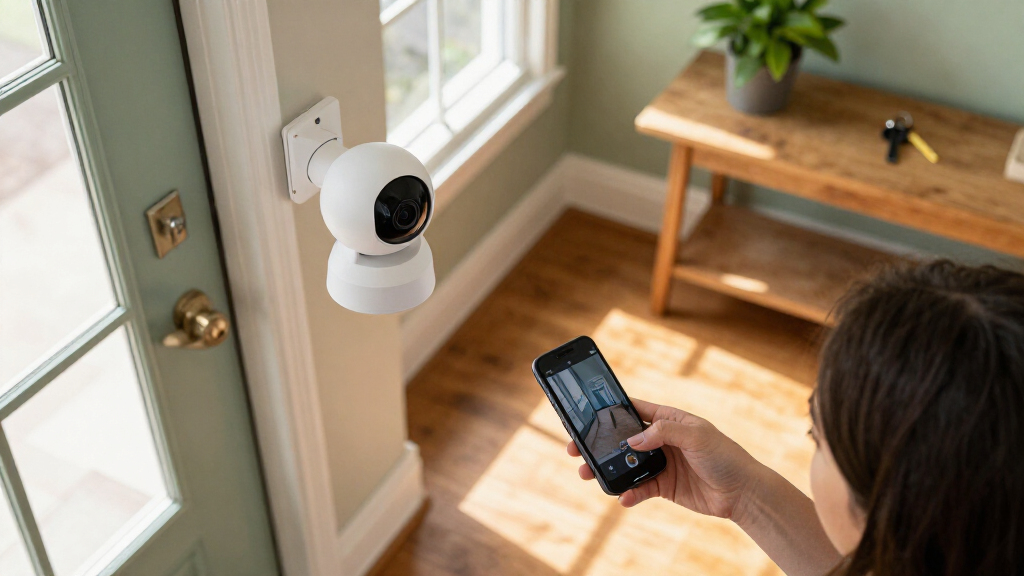

Choosing smart home security cameras is often a choice between a permanent system and one that is easier to install and reposition. Wired cameras connect to power—and, depending on the system, may also use a cable for data—while wireless models send footage over Wi-Fi and draw power from a battery or outlet. That difference affects how reliably cameras stay online, where you can put them, how much installation work the home needs, and whether recording depends on a subscription or cloud service. Wired cameras suit owners who want steady coverage at fixed entry points and can handle installation. Wireless cameras are a better fit for renters, smaller setups, and people who value flexible placement. Neither label guarantees a particular storage policy or recording quality, so check the individual model before buying.

Get home appliances delivered free with Prime
- Fast, free delivery on millions of items
- Prime Video, Amazon Music and more included
- Member-only deals all year

Blink Outdoor 4 and Wired Doorbell 2K+ Home Security System, 5 Cameras, Sync Module Core, Black
- ✔ Camera quantity: 5 Outdoor 4 cameras
- ✔ Doorbell: 1 Wired Doorbell 2K+
- ✔ Video resolution: Outdoor 4: 1080p HD; doorbell: 2K (1920 x 1920)
Blink Outdoor 4 Security Camera and Wired Doorbell 2K+ Bundle, 3 Cameras, Sync Module Core, Black
- ✔ Camera quantity: 3 Outdoor 4 cameras
- ✔ Doorbell: 1 Wired Doorbell 2K+
- ✔ Video resolution: Outdoor 4: 1080p HD; doorbell: 1920 x 1920

2K Solar Wireless Outdoor Security Camera System, 4-Pack
- ✔ Camera quantity: 4 cameras
- ✔ Video resolution: 2K
- ✔ Power: Solar panel with built-in backup battery
At a Glance
| Criteria | Wired smart security cameras | Wireless smart security cameras | Winner |
|---|---|---|---|
| Installation and placement | Needs a power connection and may require cable routing or professional installation; best at planned, fixed locations. | Usually faster to install and easier to move; requires Wi-Fi and either battery charging or an outlet. | B |
| Power and upkeep | Continuous power avoids routine battery charging or replacement. | Battery models need periodic charging or replacement; plug-in models need an accessible outlet. | A |
| Connection reliability | A wired data connection can reduce reliance on Wi-Fi; power and network design still affect uptime. | Depends more on Wi-Fi quality; battery-saving modes may limit recording or responsiveness on some models. | A |
| Recording and storage | Some systems offer local recording, but storage and subscription terms vary by model. | Cloud recording is common, though local storage is available on some models; check fees and retention limits. | Depends |
| Coverage and expansion | Good for permanent, planned coverage; adding cameras can mean more cabling and setup. | Convenient for renters and changing layouts; coverage depends on Wi-Fi reach and battery placement. | B |
| Ongoing cost and value | Higher installation effort or cost can pay off for permanent coverage; storage costs depend on the system. | Lower setup burden, but batteries, accessories, or subscriptions may add recurring cost. | Depends |
Blink Outdoor 4 and Wired Doorbell 2K+ Home Security System, 5 Cameras, Sync Module Core, Black
This is the most complete fixed-camera setup in the group for a household that wants to monitor several sides of a home and the front door. Five 1080p Outdoor 4 cameras give us more positions to work with than the three-camera Blink bundle, while the included 2K wired doorbell adds a more detailed entrance view. Both camera types support live view, night vision and two-way audio, so the package can serve both perimeter checks and visitor conversations.Its main advantage over the smaller Blink bundle is straightforward: two additional outdoor cameras are included, reducing the need to leave a side entrance or yard uncovered. The Outdoor 4 cameras use two included AA lithium batteries each, with up to two years of battery life under default settings. That can make installation simpler than wiring each outdoor camera, though the batteries are non-rechargeable and actual life varies with conditions and use.We should not mistake the larger camera count for a more advanced detection system. Blink’s person and vehicle detection features require a separately sold plan, and the system connects over 2.4 GHz Wi-Fi only. Compared with the solar pack, Blink offers a doorbell and a clear defined camera layout, but its Outdoor 4 cameras have lower listed resolution and no remote pan-and-tilt. This is our strongest pick when coverage breadth and a doorbell matter more than camera mobility or all-camera 2K video.
Pros:
- Five outdoor cameras plus a 2K wired doorbell cover more entry points than the smaller Blink bundle.
- Live view, night vision and two-way audio support routine remote monitoring and visitor interaction.
- Outdoor cameras include lithium batteries with up to two years of life under default settings.
- Weather-resistant cameras operate across a stated range of -4°F to 113°F.
Cons:
- Outdoor 4 cameras use non-rechargeable AA lithium batteries.
- Person and vehicle detection features require a separately sold Blink plan.
- Wi-Fi connectivity is limited to 2.4 GHz.
Best for: Households that want five outdoor camera positions and a 2K doorbell in one fixed-camera system.
Not ideal for: Buyers who want rechargeable power, 5 GHz Wi-Fi, included smart detection features or cameras that can pan remotely.
Bottom line: We recommend this as the broadest all-in-one choice for homes that need several outdoor views alongside a 2K doorbell.
“We recommend this as the broadest all-in-one choice for homes that need several outdoor views alongside a 2K doorbell.”
Blink Outdoor 4 Security Camera and Wired Doorbell 2K+ Bundle, 3 Cameras, Sync Module Core, Black
For a home that needs a front-door view and a handful of outdoor angles, this three-camera bundle keeps the central strengths of the larger Blink system without asking us to plan around five camera positions. It includes the same Wired Doorbell 2K+ and Sync Module Core as the five-camera package, plus three Outdoor 4 cameras with 1080p video. The doorbell’s head-to-toe view can help us see visitors and deliveries, while two-way audio makes it possible to respond through the app.The choice between the two Blink bundles is mainly about coverage needs. The five-camera version is a better match for a detached home with multiple exposed sides; this one can be more sensible for a townhouse, apartment entry or compact property where three outdoor views are enough. Both use the same 2.4 GHz-only connection, non-rechargeable camera batteries and separately sold plan for smart detection features. Choosing fewer cameras does not remove those shared limitations.Like its larger sibling, the Outdoor 4 cameras are weather resistant and include AA lithium batteries rated for up to two years under default settings. The tradeoff is that the battery estimate depends on actual use and conditions, and ongoing replacement remains part of ownership. Compared with the solar pack, this bundle gives us a doorbell and an established fixed layout, but lacks 2K outdoor cameras, pan-and-tilt and the solar system’s listed AI human detection. It is a focused choice for a modest coverage plan rather than the most expandable-feeling package here.
Pros:
- Combines three outdoor cameras with a 2K wired doorbell and Sync Module Core.
- Doorbell head-to-toe framing and two-way audio support entrance monitoring.
- Outdoor cameras include batteries and mounting kits for a wire-free camera setup.
- Weather-resistant design supports outdoor placement across the stated operating range.
Cons:
- Three Outdoor 4 cameras provide less coverage potential than the five-camera bundle.
- Smart detection and extended cloud video storage require a separately sold plan.
- The Outdoor 4 batteries are non-rechargeable and Wi-Fi is 2.4 GHz only.
Best for: People who want a 2K doorbell with three outdoor camera views for a smaller home or a limited set of monitoring points.
Not ideal for: Households that need extensive perimeter coverage, all-camera 2K video or adjustable pan-and-tilt views.
Bottom line: We would choose this bundle when a doorbell and a few outdoor views cover the property without needing the larger package.
“We would choose this bundle when a doorbell and a few outdoor views cover the property without needing the larger package.”
2K Solar Wireless Outdoor Security Camera System, 4-Pack
This system stands apart from both Blink bundles by making the outdoor cameras the whole story: four 2K solar-powered cameras with built-in backup batteries, spotlight color night vision and remote pan-and-tilt control. The listed 360° pan-tilt coverage can help a camera follow a broader area than a fixed Outdoor 4 view, and AI human detection gives the system a listed detection capability without the separately sold Blink plan required for Blink smart detection features.Power and placement are its defining advantages. A solar panel can reduce routine battery handling, and dual-band Wi-Fi supports both 2.4 GHz and 5 GHz networks, unlike the Blink options. But we need to place the panels where they can get enough sun; shaded eaves or weather with limited sunlight can reduce charging performance. The system also lacks a doorbell, so it is less complete for front-door visitor monitoring than either Blink bundle.Compared with the three-camera Blink pack, this system gives us one additional camera, higher listed resolution for each camera and adjustable views, but no bundled wired doorbell. Local recording requires an optional microSD card that is not included, while cloud storage is another option. It makes the most sense when flexible outdoor coverage, solar power and human detection matter more than a single unified doorbell-and-camera package.
Pros:
- Four 2K cameras combine solar panels with built-in backup batteries for wire-free placement.
- Remote pan-and-tilt control provides adjustable coverage across a broad area.
- Spotlight color night vision, AI human detection and two-way audio support active monitoring.
- Dual-band Wi-Fi supports both 2.4 GHz and 5 GHz networks.
Cons:
- Solar charging performance depends on sufficient sunlight at the installation location.
- A microSD card for optional local storage is not included.
- There is no doorbell camera in the package.
Best for: Buyers who want solar-assisted outdoor cameras with adjustable views, 2K video and listed AI human detection.
Not ideal for: People who need a doorbell camera, dependable charging in shaded locations or local storage included in the box.
Bottom line: We recommend this system for flexible outdoor views and solar-assisted power, provided its camera-only setup fits the home.
“We recommend this system for flexible outdoor views and solar-assisted power, provided its camera-only setup fits the home.”
As an Amazon Associate we earn from qualifying purchases.
Key Differences
The main practical divide is ongoing convenience versus fixed-system dependability. Wireless cameras generally take less effort to install and are easier to reposition, which matters in rentals or when you are still deciding where coverage is most useful. Their flexibility comes with upkeep: battery models need charging, and wireless performance depends on Wi-Fi reaching the camera reliably. A weak signal or power-saving setting can affect how promptly a camera responds or what it records.
Wired models are a stronger fit for cameras that will stay in place and need dependable power without battery routines. Systems with wired data connections can also reduce dependence on Wi-Fi. The tradeoff is installation: routing cables takes planning, and some homes may need professional help. Recording is not automatically better or cheaper with either type. Compare local storage, cloud access, subscription fees, clip retention, and what happens if the internet goes down before treating a camera’s connection type as the deciding factor.
Detailed Comparison
Installation and placement (Wireless smart security cameras wins — major)
Wireless cameras win for quick setup and flexible placement; the gap is major for renters or anyone avoiding cable work. Wired cameras need a nearby power source and, in some systems, data cabling, but that effort makes sense for fixed locations such as a main entrance. Wireless still needs a usable Wi-Fi signal and a charging or outlet plan.
Power and upkeep (Wired smart security cameras wins — moderate)
Wired cameras win because continuous power removes battery charging from the routine; the advantage is moderate for a small system and larger across many cameras. Battery-powered wireless cameras can be placed where outlets are inconvenient, but owners must recharge or replace batteries. Plug-in wireless cameras avoid that chore while keeping cable placement constraints.
Connection reliability (Wired smart security cameras wins — moderate)
Wired cameras have the edge when they use a direct data connection, since they rely less on Wi-Fi coverage; the gap is moderate in homes with weak or congested wireless networks. A wired camera that still uses Wi-Fi for data does not get this full benefit. Wireless can work very well with a strong signal, but distance from the router, walls, and network interruptions can affect access and alerts.
Recording and storage (major difference)
There is no automatic winner: wired and wireless products may offer local recording, cloud recording, or both. The difference is major only when one model’s storage policy better matches the owner’s privacy, outage, and budget needs. Compare whether recording requires a subscription, how long clips are kept, and whether the camera can save footage if the internet connection fails.
Coverage and expansion (Wireless smart security cameras wins — moderate)
Wireless has a moderate advantage when coverage needs may change: moving a camera or adding one can be simpler if Wi-Fi reaches the new location. Wired is a better fit for a defined set of permanent camera positions, though expansion can require new cable routes. For either type, check the actual field of view, night performance, detection features, and placement limits rather than assuming connection type determines image coverage.
Ongoing cost and value (major difference)
Value depends on the complete system rather than a lower camera price alone. Wireless can cost less to set up, especially when installation would otherwise require cable work, but batteries, accessories, or cloud subscriptions may add expense. Wired systems can justify higher upfront installation costs for owners who want permanent coverage and steady power. Compare the total equipment, installation, storage, and upkeep costs over the time you expect to use the cameras.
Wired smart security cameras: Pros and Cons
Pros:
- Continuous power avoids battery charging.
- A wired data connection can reduce dependence on Wi-Fi.
- Well suited to permanent camera locations.
Cons:
- Cable routing adds installation work and may require professional help.
- Moving cameras or expanding coverage can involve new cabling.
- Some models still depend on Wi-Fi or paid cloud storage.
Wireless smart security cameras: Pros and Cons
Pros:
- Typically simpler to install without routing data cables.
- Easier to reposition as needs change.
- Battery models can reach locations without a nearby outlet.
Cons:
- Battery models need charging or replacement.
- Performance depends on Wi-Fi coverage and network stability.
- Subscriptions, batteries, or accessories can add recurring costs.
Who Should Choose What
Choose Wired smart security cameras if:
- You own the home and want cameras to stay at fixed entry points.
- You prefer continuous power and want to avoid battery upkeep.
- Your Wi-Fi is unreliable and the wired system you are considering supports a direct data connection.
Choose Wireless smart security cameras if:
- You rent or want to avoid drilling and cable routing.
- You expect to move cameras or change your setup.
- You have reliable Wi-Fi and are comfortable charging batteries or choosing plug-in models.
Skip both if: Neither fits if you cannot provide reliable power or network access where coverage is needed; address those constraints or consider a camera system designed for that location.
Value for Money
Paying more for a wired installation is worthwhile when cameras will stay in place for years and constant power or a direct data connection solves a real reliability problem. It is harder to justify for a small setup that you may move soon. Wireless often offers better value when it avoids installation work, but include replacement batteries and any required cloud plan in the total cost. Before choosing on price, check the specific camera’s recording options: a low-cost model can become expensive if useful clip history requires an ongoing subscription.
Final Verdict
Choose wired smart security cameras for permanent coverage when you can handle the installation and value steady power; select a system with a direct data connection if Wi-Fi reliability is a concern. Choose wireless cameras for a rental, a smaller setup, or a home where flexible placement matters more than avoiding battery maintenance. For most people deciding between the categories, installation constraints are the first filter and storage terms are the next: compare the specific models’ power, connection, recording, and subscription details before committing. Wireless is the more practical default for easy setup, while wired is the stronger long-term choice for fixed, continuously powered coverage.
Frequently Asked Questions
Are wired smart security cameras more reliable than wireless cameras?
They can be, especially when the wired system also uses a direct data connection and Wi-Fi is weak. Wired power avoids battery downtime, but outages, network design, and the camera’s recording setup still matter.
Do wireless security cameras need a subscription?
Not always. Some models offer local storage without a monthly plan, while others limit useful clip history or features unless you subscribe. Check storage duration, alert features, and what recordings remain available without payment.
Are wireless cameras a good choice for renters?
Often, yes. They are usually easier to install and move when a lease ends. Confirm that the camera can be positioned within Wi-Fi range and that its power needs—battery charging or an outlet—work for the location.
Is a wired security camera system worth the installation cost?
It can be worth paying for when cameras will stay in fixed positions and continuous power or a wired data connection matters to you. If you need temporary coverage or expect to relocate cameras, wireless may deliver better value after installation costs are included.