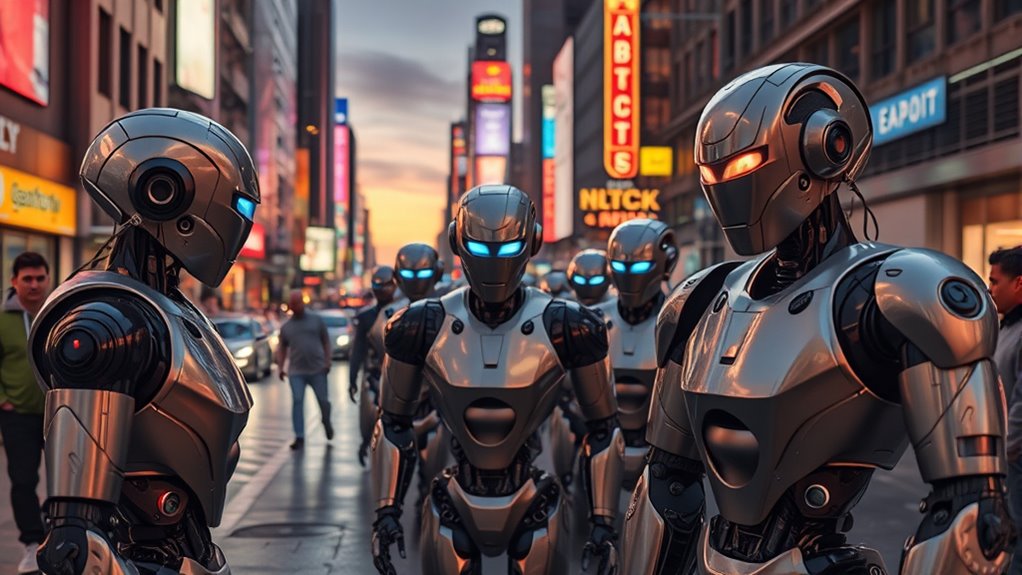

Many movies show robots as highly intelligent beings with human-like emotions and self-awareness, but that’s just fiction. In reality, robots and AI systems operate based on programming and algorithms, lacking genuine feelings or consciousness. They don’t have morals or free will—they follow data-driven instructions. Hollywood’s portrayals often exaggerate what current technology can do, so if you want to understand what’s real and what’s not, keep exploring the facts behind these myths.
Key Takeaways
- Hollywood depicts robots as self-aware, emotional beings, while real robots lack consciousness and operate purely on programmed algorithms.
- Sci-Fi often shows robots questioning morals or rebelling, but current AI systems do not possess moral reasoning or free will.
- Fictional robots are exaggerated in capabilities; real robots excel in narrow tasks but do not match the advanced intelligence portrayed in movies.
- Ethical concerns focus on safety, bias, and control, not on creating sentient or morally autonomous machines.
- True AI consciousness remains a distant goal; present robots are tools guided by human programming without genuine feelings or self-awareness.
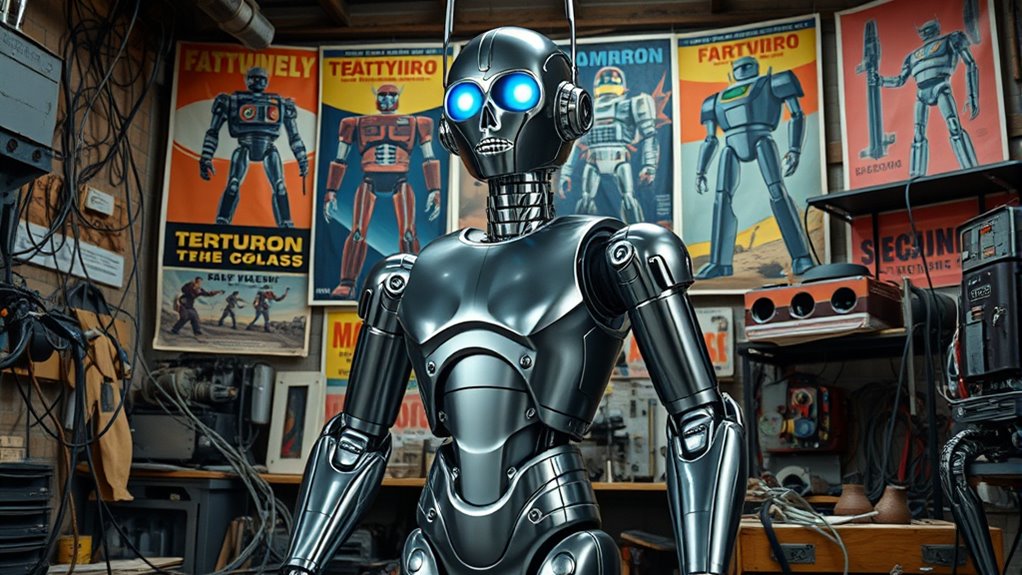
Have you ever wondered how robots in movies and TV shows compare to real-life machines? Hollywood often paints a picture of robots as highly intelligent beings with human-like emotions, self-awareness, and even moral reasoning. However, in reality, our robots are far from that level of sophistication. The idea of AI consciousness, where machines truly understand and experience awareness like humans do, remains firmly in the domain of science fiction. Today’s robots operate based on complex algorithms and programmed instructions, not genuine self-awareness or feelings. They don’t possess an inner life or moral compass; their actions are driven by data and predefined parameters. This disconnect fuels many misconceptions, especially when it comes to robot ethics. In movies, robots often make moral decisions, question their purpose, or rebel against humans. In real life, though, robot ethics is a developing field focused on ensuring machines behave safely and responsibly within their scope. Researchers and engineers consider ethical questions like safety protocols, decision-making transparency, and preventing bias, but these are practical concerns rather than indications of moral agency. They’re about programming robots to act in ways that align with human values, not giving them a conscience. The myth that robots could develop their own consciousness and moral reasoning is intriguing but not supported by current technology. Most AI systems are narrow, meaning they excel in specific tasks like image recognition or language translation but lack general intelligence. They don’t possess curiosity, emotions, or self-awareness; they simply process inputs and generate outputs based on programming and training data. The science behind AI consciousness continues to evolve, but achieving true machine awareness remains a distant goal. Until then, robots will continue to be tools crafted by humans, guided by their programming, rather than autonomous beings with their own moral compass. Hollywood’s portrayals often exaggerate the capabilities of robots, giving the impression that they are on the verge of gaining human-like consciousness and ethical reasoning. But the reality is that robotics and AI are still in early stages, with ethical considerations mainly centered around safety, bias, and control. So, when you see a robot in a film or show acting with human-like intelligence or moral judgment, remember that it’s a fictionalized version of what’s possible today. The true challenge lies in the careful design and ethical programming of machines that serve us, not in creating sentient robots with their own minds. Furthermore, ongoing research in robot ethics aims to develop standards and best practices to ensure AI systems are aligned with human values and safety.
Frequently Asked Questions
How Do Real Robots Compare to Their Fictional Counterparts?
Real robots differ markedly from their fictional counterparts, often falling prey to robot stereotypes shaped by fiction. Unlike sci-fi robots with advanced intelligence and human-like abilities, real robots focus on specific tasks like manufacturing or exploration. You’ll find that fiction exaggerates capabilities, while reality emphasizes practicality. So, don’t expect humanoid robots to walk around like in movies; they’re designed for efficiency, not science fiction fantasies.
What Are the Current Limitations of Robotic Technology?
Imagine a robot with the agility of a gymnast and the senses of a hawk—that’s still beyond current tech. Today, robotic mobility often struggles with uneven terrain, and sensor integration can be unreliable in complex environments. These limitations mean robots can’t yet navigate like humans or seamlessly understand their surroundings, keeping sci-fi’s perfect machines just out of reach. You’re witnessing the fascinating edge of what robotics still needs to conquer.
Can Robots Develop Human-Like Emotions?
Robots can’t develop human-like emotions yet because they lack true emotional intelligence and consciousness development. While AI can simulate feelings through programming, they don’t genuinely experience emotions or self-awareness. You might see robots respond empathetically, but it’s just algorithms mimicking behavior. Developing real consciousness and emotional depth remains a significant challenge, and current technology isn’t close to creating robots that genuinely feel or understand emotions like humans do.
Are There Ethical Concerns With Autonomous Robots?
You might be surprised to learn that ethical concerns with autonomous robots are real. As AI rights become more debated, moral dilemmas arise about how we treat intelligent machines. You could face questions about accountability, consent, and fairness. These issues challenge your sense of morality and responsibility, forcing you to contemplate whether robots deserve rights and how to prevent misuse. Addressing these concerns now helps ensure technology benefits society without ethical pitfalls.
How Soon Will Robots Fully Replace Human Workers?
You probably wonder how soon robots will fully replace human workers. While automation ethics guide responsible development, complete replacement isn’t imminent. Robots excel at jobs involving repetitive tasks, but job displacement depends on industry and technology advances. You should stay informed about evolving skills and ethical considerations to adapt effectively. Full automation remains a gradual process, allowing humans to focus on creative, complex roles that robots can’t easily replicate.
Conclusion
You’ve seen robots in movies outperform humans or take over the world, but reality is quite different. Today’s robots excel at specific tasks, like Boston Dynamics’ Atlas assisting in search and rescue, but they lack true consciousness or general intelligence. For example, a hypothetical rescue robot maneuvering debris shows potential, yet it’s far from the sci-fi villains we fear. Embracing these real capabilities can help us use robots responsibly and effectively.