
Robot vacuums navigate your home in two main ways: systematic mapping and random cleaning. With mapping, your device uses sensors and cameras to create detailed home layouts, ensuring efficient coverage and less overlap. Random navigation relies on unpredictable movements, detecting dirt and obstacles to clean high-traffic spots quickly. Each method has benefits depending on your home’s layout and cleaning needs. Keep exploring to discover which approach suits you best and how these methods impact your vacuum’s performance.
Key Takeaways
- Mapping vacuums create detailed home layouts for systematic cleaning, while random vacuums rely on unpredictable movements.
- Mapping uses sensors and cameras to plan efficient routes; random navigation detects dirt-rich areas through sensors.
- Systematic mapping reduces missed spots and saves battery, whereas random patterns adapt quickly to clutter and focus on high-traffic zones.
- Mapping is ideal for complex layouts with furniture, while random navigation suits quick cleans and cluttered spaces.
- Future advancements include smarter sensors and AI for real-time path optimization in both navigation methods.
How Robot Vacuums Map Your Home
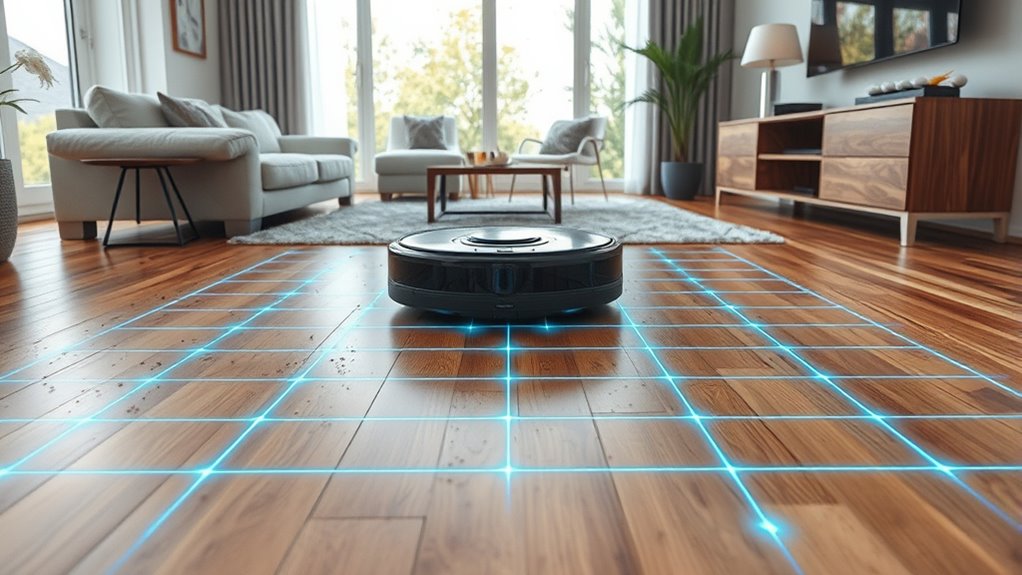
Robot vacuums use a variety of sensors and cameras to create a map of your home, allowing them to navigate efficiently. As they move, obstacle detection helps them identify furniture, walls, and other obstacles, ensuring they avoid collisions and plan ideal routes. These sensors also monitor the environment to detect changes, like a new piece of furniture. Accurate mapping enables the vacuum to cover every area systematically, reducing missed spots. Additionally, smart navigation relies on effective battery management; the robot keeps track of its power levels and knows when to return to the charging station. By combining obstacle detection with intelligent mapping, your robot vacuum maximizes cleaning efficiency while conserving battery life, ensuring thorough cleaning without interruption.
The Mechanics of Random Navigation
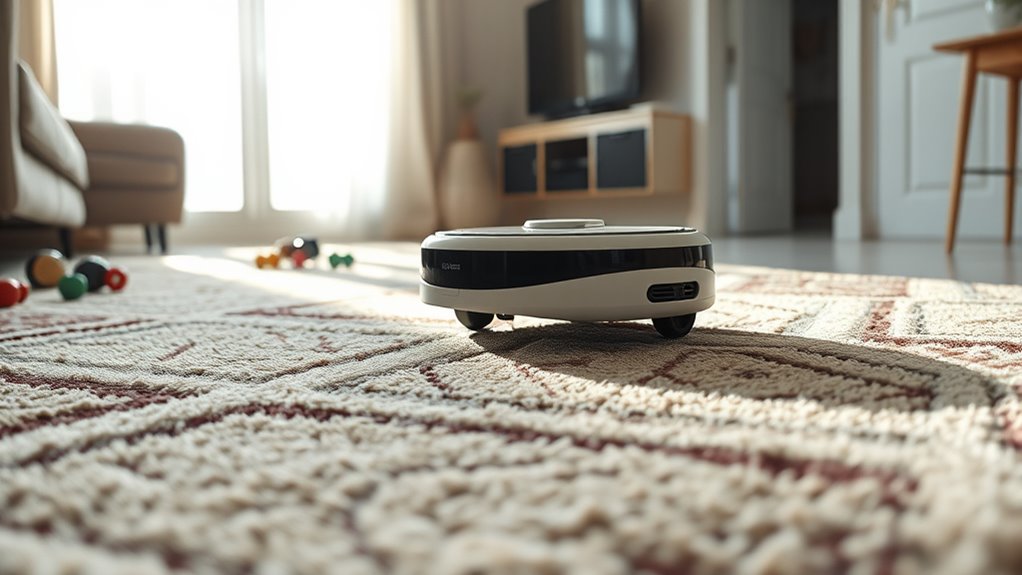
When a robot vacuum doesn’t rely on detailed maps, it often uses a random navigation approach to clean your home. This method involves unpredictable movements, which can be efficient in cluttered spaces. To do this effectively, the vacuum depends on sensor accuracy to detect obstacles and avoid collisions. Proper sensor calibration guarantees thorough coverage without missing spots. Battery management is essential here; the vacuum randomly explores, so it needs to optimize its cleaning route to conserve power. Key aspects include:
- Using sensors to detect walls and objects
- Changing direction upon obstacle contact
- Managing power to maximize cleaning time
- Ensuring complete coverage without missing areas
- Returning to dock efficiently for recharging
This approach balances simplicity with practicality, especially in homes lacking detailed mapping systems.
Advantages of Systematic Mapping
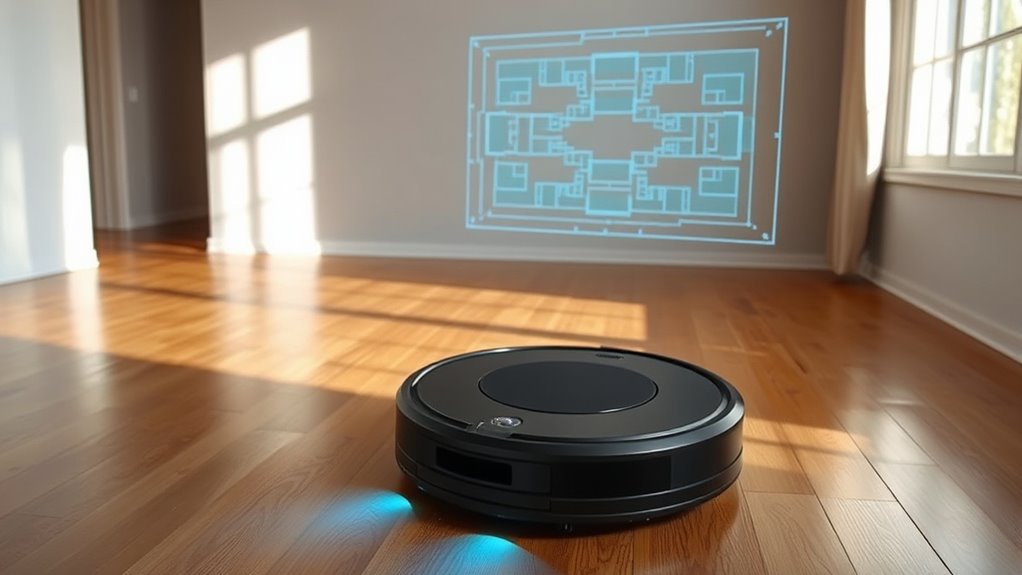
Systematic mapping allows your vacuum to create a detailed layout of your home, enabling it to plan the most efficient cleaning path. With this approach, your robot can optimize coverage, reducing missed spots and overlapping areas. This improves mapping efficiency, meaning your vacuum spends less time cleaning and conserves battery life. Additionally, systematic mapping ensures cleaning consistency, as the robot follows a logical route rather than random movements, leading to more thorough results. You’ll notice a more uniform clean across different rooms and surfaces. This method also helps your vacuum adapt to changes in your environment, such as furniture rearrangements, by updating the map accordingly. Overall, systematic mapping enhances your robot’s performance, making it a reliable and effective cleaning companion.
Benefits of Random Cleaning Patterns
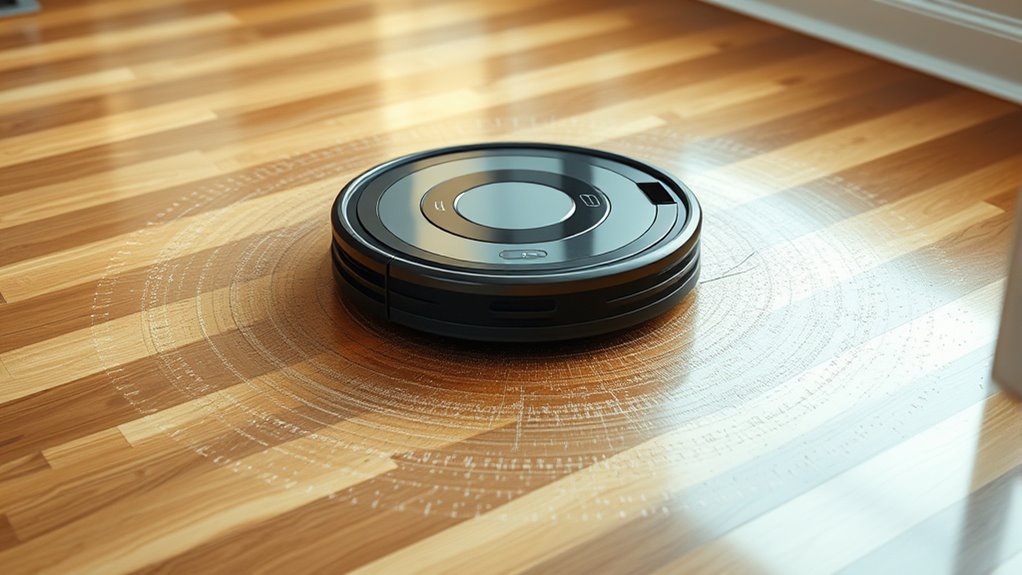
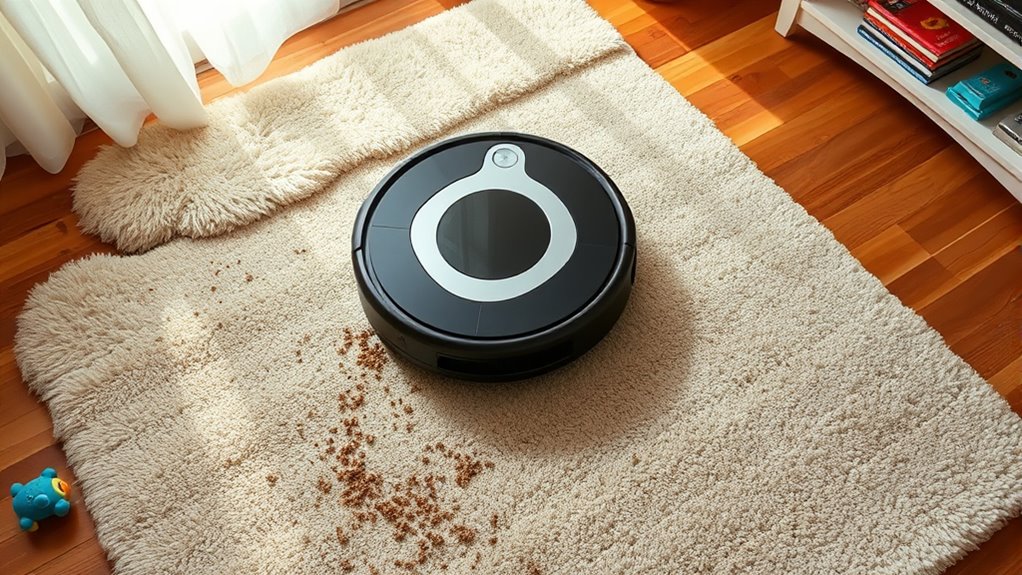
Random cleaning patterns can be surprisingly effective because they cover your floors without the need for complex mapping. By moving unpredictably, your robot vacuum can quickly detect dirt-rich areas and focus cleaning efforts there. Its built-in dirt detection sensors identify high-traffic spots, ensuring thorough cleaning. Additionally, obstacle avoidance technology helps prevent collisions, allowing for seamless navigation. The benefits include:
Random cleaning patterns quickly detect dirt and adapt to cluttered spaces without complex setup.
- Covering unexpected areas missed by systematic routes
- Reducing the risk of getting stuck around furniture
- Adapting to changing floor layouts without recalibration
- Saving on initial setup time and complexity
- Providing effective cleaning in cluttered spaces
Factors to Consider When Choosing a Navigation Method
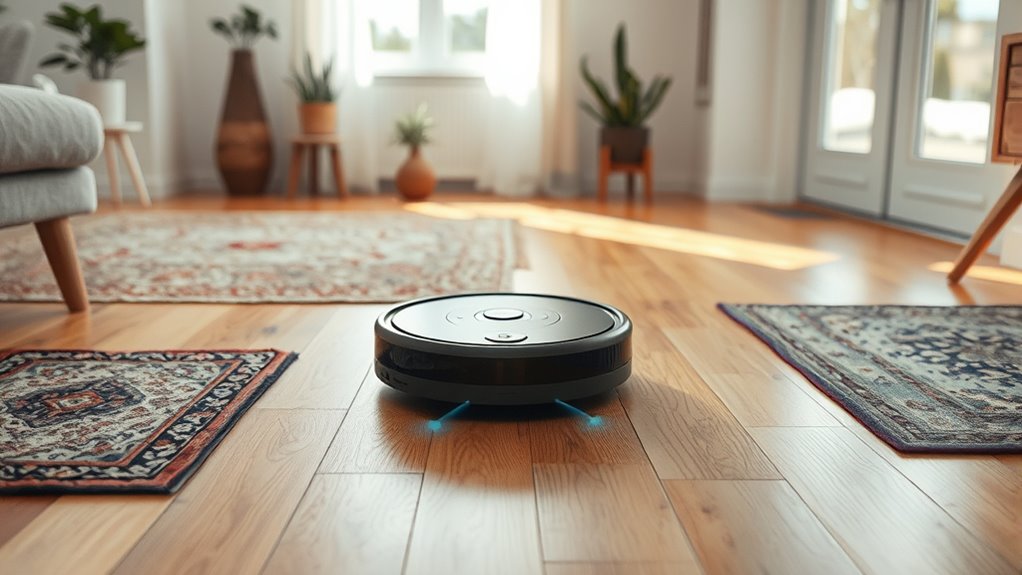
Choosing the right navigation method for your robot vacuum depends on several key factors. First, consider sensor placement, as well-placed sensors improve obstacle detection and mapping accuracy. If your space has many furniture pieces or tight corners, mapping navigation might be more effective. Second, evaluate battery life—some navigation systems, like mapping, often consume more power due to continuous scanning and processing, which can limit cleaning time. Conversely, random navigation typically uses less energy but may require multiple passes to cover the area thoroughly. Additionally, think about your cleaning needs; if you want efficient, systematic coverage, mapping is better. For quick, casual cleanings, random navigation might suffice. Balancing sensor placement and battery constraints helps you choose a method that best suits your home and lifestyle.
Future Trends in Robot Vacuum Navigation
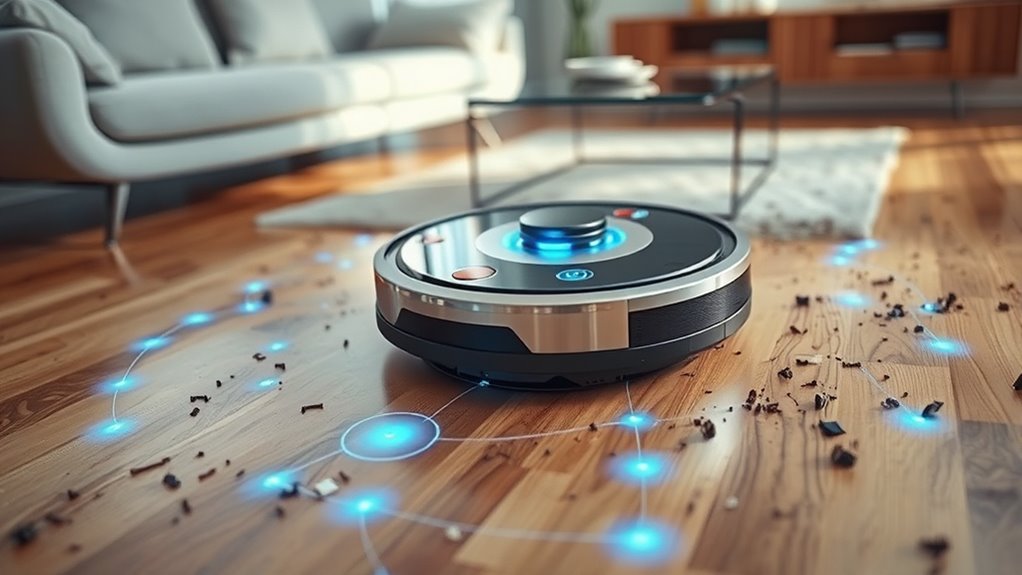
Advancements in artificial intelligence and sensor technology are driving significant improvements in robot vacuum navigation. Expect future models to feature smarter sensor technology that detects obstacles more accurately and adapts to diverse environments. As algorithm complexity increases, vacuums will optimize cleaning paths in real-time, reducing time and energy use. You’ll see innovations like enhanced mapping capabilities, improved object recognition, and seamless multi-floor navigation. Additionally, these trends include:
Future robot vacuums will feature smarter sensors and AI-driven navigation for more efficient, adaptive cleaning across complex environments.
- Adaptive algorithms that learn your home’s layout over time
- Integration of AI for better obstacle avoidance
- More precise sensor technology for complex surfaces
- Multi-floor and multi-room navigation without manual input
- Increased automation and user customization options
These advancements will make your robot vacuum more efficient, intuitive, and capable of handling complex spaces effortlessly.
Frequently Asked Questions
How Does Robot Vacuum Navigation Impact Cleaning Efficiency?
Your robot vacuum’s navigation greatly impacts cleaning efficiency by ensuring thorough coverage. With better mapping accuracy, it plans ideal routes, reducing missed spots. Advanced obstacle detection helps it avoid furniture and objects, preventing delays and damage. When navigation is precise, your vacuum cleans more effectively and quickly, saving time and energy. So, choosing a model with strong mapping and obstacle detection features means a cleaner home with less effort on your part.
Can Navigation Methods Adapt to Changing Home Layouts?
Your robot vacuum can indeed adapt to changing home layouts through adaptive mapping and dynamic navigation. These advanced methods allow the device to update its internal map as furniture shifts or rooms are rearranged, ensuring thorough cleaning without missing spots. By embracing these capabilities, you gain a smarter cleaning assistant that adjusts seamlessly, making maintenance effortless and your home always well cared for, no matter how often things change.
What Are the Maintenance Requirements for Mapping Versus Random Vacuums?
Mapping vacuums require regular maintenance of sensor calibration to guarantee mapping accuracy. You’ll need to clean sensors and update software periodically. In contrast, random vacuums need less upkeep, mainly just emptying the bin and checking brushes. Both types benefit from keeping their paths clear of debris, but mapping models demand more consistent calibration to keep navigation precise and effective.
Do Navigation Types Influence Noise Levels During Operation?
Think of your robot vacuum like a quiet librarian versus a noisy street performer. Navigation types do influence sound levels; mapping vacuums tend to operate more quietly because they plan efficient routes, reducing noise disturbance. In contrast, random vacuums often move more chaotically, which can increase sound levels. So, if you value a peaceful home, a mapping vacuum’s quieter operation might be your best choice.
How Do Navigation Strategies Affect Battery Life and Runtime?
Your robot vacuum’s navigation strategy impacts its battery life and runtime considerably. With mapping accuracy, the robot plans efficient routes, reducing unnecessary movements and conserving energy. Conversely, random navigation often leads to higher energy consumption due to repeated coverage. Choosing a mapping-based system extends your vacuum’s runtime, as it optimizes cleaning paths and minimizes battery drain, allowing you to clean more thoroughly without frequent recharging.
Conclusion
Choosing between mapping and random navigation shapes your robot vacuum’s destiny. Imagine a tiny explorer, bravely conquering every corner, leaving no speck of dust behind—like a superhero on a mission. Whether you prefer the precise genius of mapping or the wild, unpredictable charm of random cleaning, your decision transforms your home into a spotless battlefield. So, pick your champion and watch it sweep through your space like a whirlwind of cleanliness, unstoppable and flawless!